Sail On, Sailor

Mike and I haven’t felt much like sailors lately. But all that is about to change. Recall that on July 24, on our way to Port Ludlow from Seattle, our headsail got damaged. We can finally write about how we solved that problem.
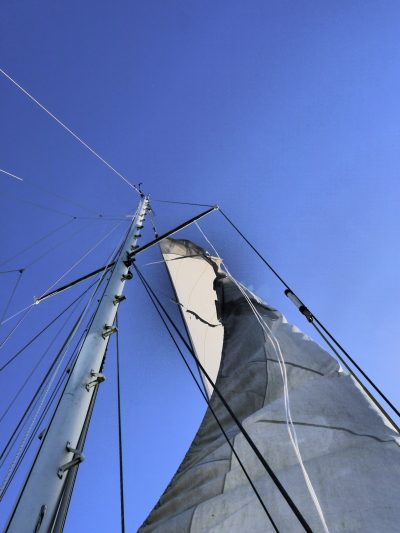
Ouch.

We knew our headsail was old. It had been repaired once before, but we thought it was in better condition. Shows how much we know! Some of the stitching on the sacrificial sunbrella cover had eroded, probably due to UV damage over the years. If previous owners sailed this boat like we do, then the headsail is the most used sail on the boat. It will have had the most exposure. Anyhoo, that sunbrella caught just right on a shroud and that’s all it took to destroy that part of the sail.

When we got to Port Ludlow, we borrowed Stephanie and David Gardiner’s truck (Beautiful S/V Cambria is for sale!) and took the sail up to Hasse and Company in Port Townsend. After assessing the damage, the assessment was that the sail, while old, could be made viable for awhile and might make it to Mexico if we took good care.  Although there was UV damage to the sacrificial cover and to the sail cloth along the leech, the interior of the sail was still good. But at the end of the day, they recommended a new sail either now or in the near future. They gave us three quotes: small meal deal, medium meal deal and the full meal deal, which meant they would make us a new sail.

Looking over the sail cloth.

I know everyone wants numbers for these things so here you go. Unfortunately in our dilligence to keep mess to a minimum aboard, I’ve thrown out the actual bid sheet. So a couple of these are round numbers, but it gives you the general idea. Your mileage, as usual, will vary with your boat:

Small fix – this included supporting the sail cloth along the leech in the torn area with wide, sticky backed sail tape, restitching the sunbrella, and restitching the tabbing at the head and the clew. This would make the sail useable, but with care. Pricetag: $375 (that’s accurate)

Medium fix – This included everything above, plus replacing the tabbing and attachment points at the head and the clew, restitch the entire sunbrella cover, plus probably a couple of other things we can’t remember.  Pricetag $845 ish

Full Meal Deal, which I had to rename the Big Gulp – new 135% headsail of 8oz dacron – $8,500  ish, plus the costs of measuring the boat in person, which would have been fun. We would have then had our measurements on record and the ability to order new sails from anywhere in the world. Yes, that’s eight thousand five hundred ish. Um. Ouch.

After consultation with Allison at Hasse and Co, we went with the small repair to get us going and make us a reasonable back up sail. She agreed that this was the best choice. Put as little money as possible into what we have, then look for another sail in much better condition. She gave us a list of used sail purveyors.

Scene from a sailmaker

I’d like to point out that Hasse and Company is a great place. For some unaccountable reason, the minute we walked in we breathed a sigh of relief and felt good about being there. Maybe it’s something about how very feminine the energy is there, and I mean that in the archetypal way. It’s a nurturing, safe place. We were welcomed warmly, and they worked hard to establish our need and fill our need on an emergency basis. Their work is first quality and their service is superior. This is a business that is secure in its own success. At no time did we feel pushed to spend more than we had to spend. They would have not held it against us if we had just taken our sail away with a nod of thanks. Neither did they ‘not have time’ to serve a cruising boat that wasn’t going to spend yachtie amounts of money. We appreciate so much their attitude of kindness and genuine interest in meeting our need, however small. They fixed our sail in record time and said ‘fair winds to you’. We were kind of sorry to leave. Their sails are beautiful, hand made by local people, and guaranteed. I’m not quibbling even a little bit about how much they cost. We just couldn’t afford it, simple as that.  That was a mighty discouraging day.

We couldn’t find a good used sail that would have been right, so we turned to fellow cruisers and FaceBook/Blogging friends Jamie and Behan Gifford of Sailing Totem. Jamie is a sailmaker and runs Zoom Sails with friend Phil Auger, having cruising sails made for fellow cruisers. They have working relationships with a couple of factories in other countries; factories they know that do work they trust.  We had ordered our stack pack from them and had been pleased with the service and the quality. So we gave Jamie a chance to bid for a new sail, still feeling a bit discouraged, I might add. This sail snafu had just cost us our circumnavigation of Vancouver Island. I guess that’s the way the wind blows.

We were able to get a bid for the new sail within 48 hours, which is amazing considering that Phil was traveling between continents at the time. We ordered a new sail from Zoom Sails, opting for premium quality dacron with a 2-ply leech. The surface area for this sail is 47.5 square meters. The cost includes sunbrella cover sewn with Tenara thread, foam luff strips, radial patches, triple stitched seams, Dyneema leech and foot cords, three sets telltails, and a nice sail bag.   Total cost, with shipping: $3510. There was another fabric option which added more UV protection for the sail, but we don’t need 20 years from a sail. We need maybe 5 years. That option would have been about 700$  more. And, in more good news, we could get the sail in about 3 weeks, rather than the 5 it would generally take. Sold!

We were visited by an entire flock of these swallows while anchored at Cabbage Island.

If you’d like more information about Zoom Sails’ service, here’s a good video from the Follow The Boat people who had their entire set of sails made by Zoom. They were fortunate enough to have Phil come to the boat and take personal measurements. The video includes footage from one of the factories with which they work. If you liked that one, here’s another one where Phil measures their boat.

To order from Jamie and Phil, we needed to pay via wire transfer because credit cards cost money to businesses so they don’t take them. We had a small glitch in the payment that we’ll share in case you ever need to avoid this. When Mike ordered the wire transfer from the bank, he put ‘sail for Galapagos’ in the subject line. This was an unfortunate and unpredictable error. It triggered an investigation into whether the money was being sent to an organization on the government’s ‘do not send money to’ list. Apparently there is a shady organization with the word ‘Galapagos’ in its name. At first, we couldn’t figure out why the money had left our account, but Phil had not received it. Then Mike got a terse email from the bank’s investigations department commanding he answer a number of questions. Failure to respond would mean we would lose our money. We’re very glad we were in an area where Mike could check email regularly!

Not leaving anything to chance, Mike replied immediately, then followed up with a phone call. The investigator released the hold right away, but it still took several more days for Phil to receive it. Everyone breathes easier once these things go through, but sheesh! Small businesses need to be paid right away! Next time we order from these guys, we’ll have to say something like ‘new sail for our sailboat’ and not use any proper nouns.

Detail

Our new sail was delivered to Friday Harbor on Wednesday, and we picked it up Thursday, thanks to Steven K. Roberts and his handy truck!  (and by the way,Steve has a main sail in good condition for sale for a very reasonable price if you might be interested. Contact Steve for details. It’s from a 44 ft sailboat. ) The new sail is beautiful! We’re very pleased and seriously ready to put it to the test!
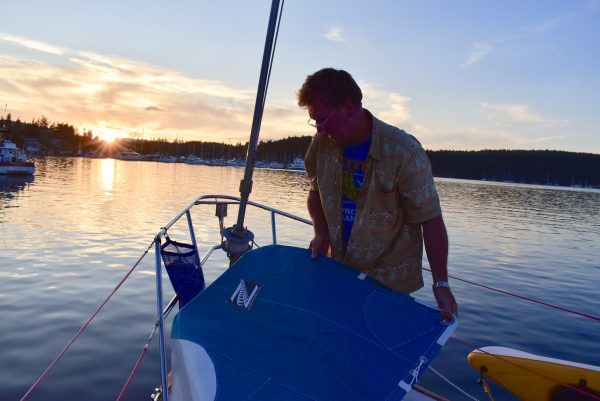
We’re still waiting for some mail to make it to Friday Harbor, but we’ll be going up to Reid Harbor on Stuart Island this weekend to get some time with my sister’s family on their boat. After that, it’s Neah Bay and the big left turn. Spinning and spitting three times in my usual deference to the sea gods on this plan.

S/V Galapagos, out.
We’ve Got Mail

Now that we are back in the land of interweb, I can get to updating the blog. Let me just say that if you are looking for the ability to make phonecalls, text, or send an occasional FB update while in Canada or Mexico, then the Verizon ‘all you can eat’ plan that includes Canada and Mexico is probably fine for you. If you want to use the internet for anything other than that, forget it. Ordering from Amazon: No. Doing a Google search: also no. Looking at more than the first ‘page’ on your FB: are you kidding? No. Loading FB comments or replying to them: that’s a ‘no’.  Getting the latest U.S. version of the news: pretty much NO. (We didn’t miss that much.) If you can ‘splain this to me, please do.

It’s not always pretty sunsets and drinks with umbrellas in the cockpit, but sometimes it is.

Even though we had good reception most places, three ‘bars’ or better, we could not effectively do anything web based.  It was an exercise in frustration, mostly for Mike, since I am not interested in trying to tame a recalcitrant electronic device. If my computer or phone won’t work, it’s got exactly 5 minutes of my messing with it before I see a shiny thing on the other side of the boat and go toward the light.  I decided I would just read my books. It’s going to be a challenge getting used to having sketchy connectivity. After all, this isn’t a vacation; it’s how we live now. And we are a ‘connected’ family. Nevertheless, we shall persist in this thing as in others.

In the flurry of activity gearing up to leaving the south sound area, our son and daughter were intrigued with the number of parcels delivered to the house. Was this Christmas in July? It was not. It was stuff for the boat, for the engine, for the solar panels, you name it: we wanted extra parts for it. But as we cruised, other needs came up and we began using the old fashioned ‘general delivery’ service that allows you to have mail sent to the post office near you and held for 30 days. We had my offshore PFD delivered to the Post Office in Port Townsend. Now that we’re in Friday Harbor again, their Post Office is our new address.

It seems like a foolproof system, sending things to a Post Office to be picked up. But there is never enough proof against fools so we share our new found wisdom with those of you who may use this delivery service in future. As we scrambled around Friday Harbor checking packages off our list in a time-consuming game of ‘scavenger hunt’, we learned some stuff. And got some good exercise in the meantime.

View from the American Camp trail around the Friday Harbor airport. Best blackberries anywhere. Shhhh.

  1. Amazon, from whom all goodness doth flow nowadays, doesn’t always deliver using the Post Office. Of course, we knew that. But when you have a house, it doesn’t matter what color the delivery truck might be.  So it wasn’t on our radar. Sometimes they use UPS. Sometimes they use FedEX. Sometimes they use a combination of those things. Unlike at home, if you think they’ve used the Post Office, but they actually used UPS, you want to know it. Fortunately, if you have *INTERNET (* see above) you can check your account to find out how something shipped.  If they use UPS, you may or may not get a phone call saying you have a package and they will hold it for 7 days. Not 30. Make sure your Amazon account has a phone number where you can be reached. Thankfully the nice folks at the Friday Harbor UPS place, down by the airport, called me when we were in Sidney and told me something had been delivered. I was pretty confused, then they were confused about why I was confused. Save yourself some stress and confusion by checking out how something will be shipped so you’ll know how long it will be held. I’m glad we were in a position to pick the Amazon order up before the 7 day ‘hold’ period was over.
  2. If you have a name like mine, Melissa White, be aware that you are not the only person with that name, even though there is always only one of ‘You’ and you are very, very special.  Imagine my surprise when Mike got an email through the blog that ‘Melissa White’ had received a package that was addressed to General Delivery in Friday Harbor, but it wasn’t for her. This alternative ‘Melissa’ somehow, without opening the package, found us on the interweb and contacted us through the blog saying she may have received my package. We are very happy we were able to pick up that email during one of the few times we could do so while in Canada. She returned the package to the Post Office and we picked it up today. But we also will allow this to be a happy accident and meet up with this other “Melissa White” to compare notes about being us. Of course, the Friday Harbor Melissa has an actual address, so she is unlikely to get things mailed to ‘general delivery’. Still, the postal worker probably thought she was doing Melissa a favor in delivering to her home. I wonder if putting something like “Yacht in Transit” in the address would have helped differentiate us from all of our dopplegangers.
  3. Sometimes things take longer to be delivered to an island. Right? So it’s nice to not have a schedule while you wait for large packages. Things that should have been delivered on Monday, might actually not be delivered until Thursday. Best to not have a schedule.
  4. It’s nice to have an actual street address with a person attached to it to have expensive parts delivered. We are grateful to Steven Roberts of Friday Harbor for letting us use his address to have a couple of larger things delivered. That reduces all kinds of worry.

    Just going to pick up our mail. Out in the middle of nowhere.

And for those of you who do not live on a boat unleashed from land, here’s how things roll for us: Yesterday we walked about three miles to get to the UPS delivery place to pick up our Amazon packages and to Steve’s street address to pick up a part for the Hydrovane installation (which we hope will now be PERFECT). We took a great path around the airport perimeter, picked extremely plump and yummy blackberries as we walked the trail and then walked along a heavily traveled road to a dirt road to the delivery location. It was a house.  Mike knocks on the door and the home owner comes to the door. ‘Hi, I’m Michael Boyte. I think you have a package for me?’.  Homeowner hands over the package containing $350 worth of Hydrovane parts. Honestly, it seemed suspicious the way things so easily went down.  Then the guy offers to drive us back to town! Winner! Who says ‘no’ to a ride when the alternative is to lug two boxes on a cart about 3 miles to town? As our daughter says, ‘This is the life you chose’. Getting the mail. That’s our ‘one thing’ we did yesterday. And it was great.

We’re getting kind of anxious to get going down the coast. All the cool kids in our class have already graduated and left home. S/V Blue is gone, S/V Bella Nave is gone, S/V Brigadoon decided to stick around here for a grand baby. We’re the only ones we know who are still ‘here’ and it’s beginning to feel a little like that clock is ticking. As of now, we sail out the strait to Neah Bay to wait for weather, if necessary, a little before Labor Day.  That’s pretty soon. May the weather be fine.


S/V Galapagos out, for now.


Cheap and Easy(ish) Boat Trick: Cockpit Shade

This summer the Pacific Northwest fell under the spell of a particularly hot couple of weeks. We had temps in the triple digits in some places, and, while I’m not complaining, it became clear that we needed something to protect our delicate pacific northwest skin from the rays of blistering sun. Those hot days reminded me that we are, in fact, headed for weather that may be even hotter, and sun that is definitely stronger. We needed shade in our cockpit!

I left openings so it’s easy to get in and out of the cockpit without detaching the cover.

Galapagos came with a full set of canvas for the cockpit, including a pretty neat shade enclosure made of some kind of heavy screen material. Alas, it was falling apart. Literally. I mean the fabric was disintegrating. We trashed it. But I began noodling out how I could make a simple shade enclosure that would fit the bill as a ‘cheap and easy boat trick’. It had to be easy to deploy and easy to store.  This turned out to be cheap, and if you have a sewing machine, which I do not, then it would be easy. I had to do everything by hand, so let’s call this ‘easy-ish’. It’s definitely easy to deploy and store.

I ordered two rolls of extra heavy Coolaroo Outdoor Shade cloth from Amazon; enough to go around the entire cockpit, including the windows in the front when they are fully open. (You can certainly order directly from Coolaroo, but it’s more expensive that way.) This fabric is rated to block 86-90% of UV rays.

To attach the side and back panels to the cockpit, I wanted to use the existing aluminum bolt rope channels (called an Awning Track on Sailrite). Yes, this is the bolt rope that is used to make sails.  This is how our current heavy canvas enclosure is attached. I ordered 12 feet of bolt rope from Sailrite. To hold the panels down onto the outside of the dodger, I used plastic grommets in the corners.

Cost of materials:

Sunshade cloth $38
Bolt rope $27.60 plus shipping
Grommets: 2 packages $8.60
Needles, thread, para cord – 0 because I have those things already.

Total cost: $74.20 plus however much I paid for shipping from Sailrite.

I know alot of people who sew all the time would probably get busy making some kind of pattern for this thing but that’s way too much trouble. I do better just holding the fabric in place and cutting around the shape, leaving enough room for mistakes and to make a neat edge. If I have to stop and make some kind of pattern, this stops being ‘easy-ish’ and falls into the ‘hard’ category. Plus I don’t have a flat surface large enough to lay out fabric of this size.

The needle is VERY sharp.

Making the side panels was dead easy once I figured out how I could stitch bolt rope by hand. This stuff is extra stiff, my fingers are old, and 12 feet is a long way to sew this stuff by hand.  I tried using Mike’s Speedy Stitcher, but it’s made to be used with heavy waxed thread. It didn’t work well with the thread I was using; heavy outdoor ‘sail’ thread. Plus it was cumbersome. My patience wore thin. What did the trick was using the speedy stitcher as an awl to poke holes along the bolt rope. Those holes allowed my heavy needle to go through with little trouble and I made short work of getting the bolt rope attached to the panels after that.

I wanted the back panel to be in two pieces and I wanted it to go all the way back to the cockpit combing, past the mizzen mast.  A previous owner had attached heavy plastic hooks along the side of the combing and these made excellent attachment points for small bungee loops that I could put through the grommets.This part of the enclosure is large, so I didn’t want to have to take it down and store it somewhere. I wanted to be able to roll it up and tie it out of the way.

All rolled up at the back of the cockpit.

The side panels are held down by putting the grommets over stainless steel screws I put in the teak dodger in strategic places. This fabric is not meant to hold snaps. The weave is too open. Grommets work better.

The most challenging part of this project was the front, which I made in two pieces. Because we wanted the windows to be able to open, I had two different measurements for the length required to go around them. Looking more at getting something functional and fast to deploy rather than something with a tailored fit, I opted to cut two lengths of the fabric that would cover the windows on each side at their widest-open setting, then fold the extra away and secure with a bungee through a grommet if the windows were closed. It’s the least pleasing part of the project visually, but it works great and I was able to leave enough space at the top to be able to see over the top of the screen.

Openings left on either side to get in and out easily and for air flow. It feels a bit like a tent inside. Cozy and cooler than the outside.

We are very happy with the results. We store the large front pieces, which we use much less often than the other parts. The back pieces stay rolled up and out of the way unless we need them. The side panels are folded and stored in cockpit storage. The whole set up is versatile. I have no idea how long this fabric will last in the tropics, given that the sun there eats things fast. But at this price, I can buy more fabric in the states when I come to visit and remake the thing in a day if necessary. The bolt rope is protected from UV as it’s underneath the dodger. I wouldn’t have to buy that again. And the grommets are cheap.

Here’s a photo of one of the front panels. Honestly we do not use them very much up here because our cockpit seats are set well back from the windows and the dodger top has a generous overhang in the front. It has to be pretty hot to deploy these. It’s possible in the future if we end up using these front pieces a lot I may decide to make 4 panels for the front, making one panel each for the opening windows and one panel that covers the two fixed windows on each side. That would require more attachment points, which means more little holes in the dodger. But it would look better and might give us even more flexibility. The way I have it now,  wanting the flexibility of opening the windows, which we almost always have open, means there has to be enough fabric to accommodate that. For now, I call this ‘good enough’. I did end up using large cup hooks tucked up under the dodger top so that I could put two little bungees on one attachment point.

Not great, but effective.

We’re still anchored here at Cabbage Island. It’s a great place and one of our favorites. S/V Galapagos, out.