The Emotion of the Ocean

I promised to write a post about the emotional side of this first passage and today, a few days later, I realize that an offshore passage on the northern Pacific is similar to childbirth. Yes, that’s right. You know that amnesia that sets in the minute that warm little body is placed in your arms? All the pain, all the work, all the laboring, all the names you called your husband during transition,  is quickly forgotten in the glow of wonder that is your new baby. At least that’s how it worked for me. And that’s how this experience is working, too. I’m starting to forget the emotional downsides of the passage and bask in the glow of being in a new place and having gotten here under our own volition. So I figured I better get to it before amnesia took over.

We enjoyed watching these Brown Pelicans dive for fish outside the Golden Gate.

The 6 days and 5 nights we spent at sea were filled with labor and focus that never ceased, even during sleeping times. There was always the movement of the boat, the droning of the engine when it was on, the sound of the waves rumbling under us; in short, it was an ‘active’ passage that took constant attention. There was really no downtime. Even when off watch, our bodies tensed to accept the crashing of the bow, or the feeling of dropping into space as we surfed down a wave front, or the heeling of the hull, or the corkscrewing as a wave took us just right. We timed our actions if we wanted to climb up the companionway ladder, or even cross the salon.  On one particular day I literally crawled across the floor to reach a cabinet under the settee as it was a safer way to travel than trying to stand up. Imagine, if you will, that your house is constantly moving this way and that; that there is never any stillness to be had. I think the lack of stillness, ever, was the hardest part for me.

It’s a lot of work for your body to accommodate this amount of motion and noise 24 hours a day for days on end. This constant stimulation can  and did cause irritability and a tendency to snap. If you are the kind of person who avoids crowds and other noisy things because energetically they are overwhelming, blue water sailing may, counter intuitively, not be for you without proper preparation.  Noise fatigue is a real thing. It causes overall tiredness and is implicated in poor decision making. If you are going offshore, you need to be aware of noise fatigue and how it’s going to impact you after several days. Get some really good earplugs like these. They are worth the money.

Pt. Bonita and our first glimpse of the Golden Gate Bridge.

With the motion of travel in the constant background, there was also the continual focus on equipment and how it was doing. Part of this is probably because it was our first multi-day passage on board Galapagos, but part is just because you can’t get complacent about systems. Mike, in particular, was acutely attuned to every noise the boat made. Was the propeller making a different noise than usual? What’s that small ‘ping’ noise? Is everything OK? Better go down and check the engine one more time. Why did the bilge pump just come on? Where is the water coming from?  Are we getting exhaust water out the back like we should? Even in sleep, our bodies were tuned in to the noises of the boat, not unlike new parents who have one ear always listening to the gentle breathing of their child. This was worse for Mike than it was for me. He knows that if something goes amiss, he’s likely to be the one that will fix it.

Most sailors are familiar with all these activities and these feelings. In fact, for some of us the boat motion during a ripping good sail is part of the fun. I actually love the feeling of sailing down a wave. But the intensity of them, the unceasing movement, the knowledge that there will be days of this and no quiet anchorage to drop the hook at the end of the day; that’s much different on the open ocean than coastal cruising. It’s not the existence of these things that wears on the psyche. It’s their magnitude and their constant companionship. There is no ‘off’ button on the sea. Knowing this academically is much different than knowing it with your body.

We prepared for years to do this trip and once we were away from Neah Bay I breathed a sigh of relief. All of the goodbyes had been said. All the preparations that were going to be made had been made. Our boat was not perfect, but it was safe. Now we were just going to do it. I didn’t feel excitement, I just felt acceptance. “Here it is.”, I thought. “Now we do this thing. Whatever happens we’ll deal with it.”  I never had any fear about this passage. I never had any anxiety about it. And everyone knows I have anxiety so that’s weird. But I think I came to some kind of fatalistic view where I just let go of worry and stepped off the cliff. So fear was something I did not have.
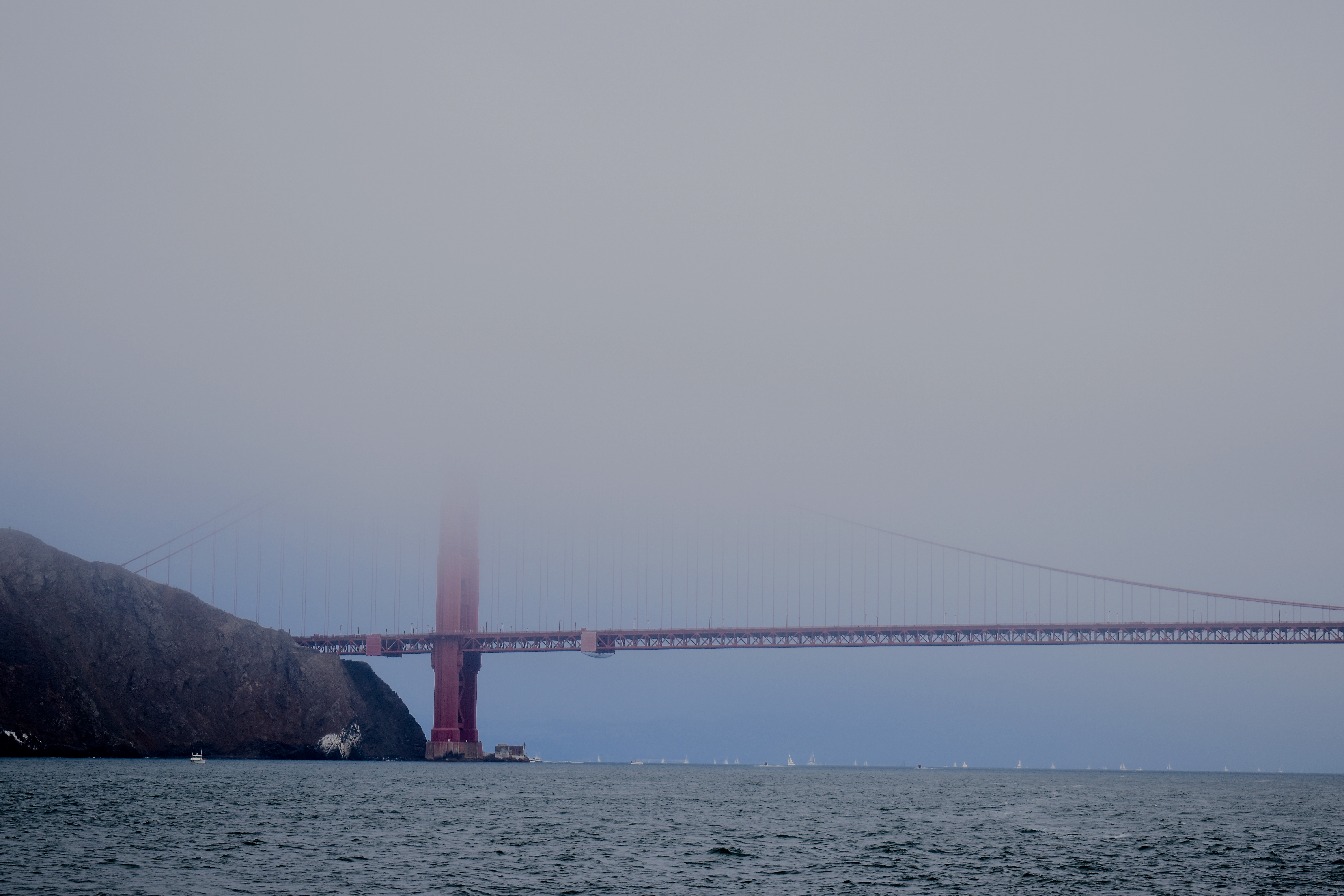
Approaching the bridge in the usual fog.

What I did have was 35 years of marriage to a man I know well and who I trust with my life. Let me tell you this: if you don’t trust the person you are on your boat with, don’t leave the shore. The ocean is big, and it’s lonely out there. You have to know you can count on your partner to have your back, to understand how you act when you get tired or afraid, and to be able to communicate with you.  These things are as important as knowing how to sail the boat. Work these systems out before you leave the dock.

What I also had was a boat I trusted. This is key. There have been a number of times before we left that I’ve worried we bought the wrong boat. Galapagos is very big and heavy. I hate the way she handles in a close space with her full keel.  I still get anxiety about going into marinas, although that’s way better now than it was. But we trusted Ted Brewer to know what he was doing when he designed her. And let me tell you this: she is excellent in every way on the sea. We totally have the right boat. I never even one time had a fear that she couldn’t handle way more than we could. And when the sails were set and she was used as a sailing vessel, the ride was comfortable if not always smooth.  I shudder to think how this trip would have been had we kept our beloved Cal 34, Moonrise, and sailed her down to Mexico. If I had survived this trip in that boat, I would have kissed the ground in California and taken the first plane home. Feeling safe in your boat is number one. Feeling safe with your partner on board is number two.

So as we motored into foggy conditions, as usual, out of Neah Bay, I was accepting of whatever the trip was going to hold and confident we would make it to California. I had confidence in our boat and in my partner. Those things were key.

Approaching the Golden Gate Bridge, Mike and I both felt elated that we had accomplished this.

Then we began to sail. It was like all the greatest sails in all the sailing books you’ve read. The wind was 10-15 knots, the seas were gentle and an incredible shade of Prussian Blue. We saw humpback whales. We put out the headsail and the main and we flew along for miles and miles and miles just blissing out to finally being out on the sea, sailing this boat like she was meant to be sailed. We were having such a great time sailing that we completely paid no attention to how far offshore we were going. Turns out, we ended up 100 miles offshore before we decided we better tack back in. It was kind of a shame. We had such a good groove going. I think that was really the highlight of the trip, before the fatigue set in. After the second night watch, things began to be more difficult.

Note from my logbook:

As the sun goes down I suddenly need a break from the cockpit. I am hand steering down waves trying to keep the boat from wallowing. We had taken the main down as we are traveling almost dead downwind to make any way south. The rolling is ridiculously tiring as the boat swings wildly from side to side. The vane can’t keep up with it and Mike is concerned about the autopilot. I suggested taking the main down (the wind was almost dead behind us and it was blanketing the jib) and it was quite a job, fraught with peril. I am glad for harnesses. Some slugs came out of the track, which didn’t surprise me at all and only made me irritated we didn’t prioritize a new track and get those slugs replaced. Now the main is out of commission until we have quiet water to get it sorted, not that quiet water is bloody likely out here. It’s not even stowed properly, just secured so it won’t blow around. Mike could barely hang on what with the waves and the rolling and I was trying to keep the jib flying and also help stow the aft part of the sail and reef lines. Ridiculous and dangerous and absolutely will not happen again. After hand steering and wallowing for 30 minutes and after that experience I needed a break. I had been in the cockpit for several hours. Below was a mess. I could barely walk from being flung around. Even in the midship cabin the motion was intense. Finally Mike turned the engine on and we began making way. (I slept.)

Now at 10:30 PM on watch and we are traveling 6.5-8 knots with the headsail and engine on a good track south and east. It’s a beautiful night with bright moon and waves just breaking at the top. Galapagos is racing the swells and they rumble under us with a great roar on occasion. I wish I could see them better but it’s magnificent.”

An emotional high point was when we were surrounded on all sides by hundreds of Pacific Whiteside Dolphins (we think?)  hunting together. It was fantastic!

What a difference sleep makes in attitude and in resilience!

And that leads me to this: the single most important thing that impacts the emotional state during a passage at sea is fatigue; both noise fatigue and sleep deprivation. Sleep deprivation leads to emotional fragility. Know this and be aware of your own emotional patterns. Had I not been overly tired, I would have handled the mainsail fiasco much better and not almost had a meltdown, leaving Mike to take over my watch. I would have been aggravated by the mainsail issue, and determined not to see us put in that position again, but I wouldn’t have felt close to breaking down. It was truly a low point for me and I had to speak sternly to myself to snap out of it.

During this passage we did three hour watches, but I believe next time we will try 4 hour watches at night. We chose 3 hours because on our other overnight trips that’s what worked for us. But the difference is that those were only over 1 night, not several. You need enough sleep to get REM sleep and deep sleep. With a 3 hour watch, you just can’t get enough of either. Having an extra crew member, if it’s the right person, would also be a great way to share the load. We continue to be on the fence about this one.

Sunshine and warm weather greeted us as we emerged from the foggy world on the other side of the bridge. How do they do that? It’s like magic.

When we finally arrived by Bonita Point and approached the Golden Gate Bridge, I was surprised at the emotion that swept through me. We had come from a world of fog and shades of white and grey. As we passed underneath the bridge, it was like opening a door into a technicolor world of magic, like the Kingdom of Oz appeared to Dorothy. Suddenly, there was blue sky and hundreds of sailboats and bright sun and sparkling water. Had we paid attention, we probably could have heard the Angels sing. We shared a long hug and a kiss, and some tears that we had made it, we had done this thing we set out to do. We felt elated. We had given birth to a dream, then a plan. We had put the plan into action and so far, it had worked out.  We knew if we had made that passage all in one stretch, we could do another. And another. The world was now open to us in ways it was not before.


I


3 AM Coffee

Our first passage is finally behind us. We left Neah Bay on September 1 in fog, and we arrived at Pt. Reyes National Seashore just outside the Golden Gate on September 6, also in fog. How far south do we need to go to get out of the blasted fog? As we dropped anchor we were what’s known as ‘dog tired’, which means you’ll do anything to get some sleep. We anchored in Drake’s Bay behind Pt. Reyes, took hot showers, and hit the sack. The Proscecco in the fridge would have to wait.

Pt. Reyes. We will revisit this place on the way out. I still want to go ashore.

Mike fell instantly asleep. I did not. Now, understand that I had been sleeping like a baby on benedryl during my off watch hours during the passage. Mike and I did a three hour rotation starting in the evening when the sun went down, which, by the way, happens sooner and sooner the further south you go, in case you didn’t remember that. We sure didn’t. When Mike popped his head up the companionway to change shifts I wasted no time and very little effort getting undressed and into the midship cabin berth. I would be out in less than 2 minutes, sleeping like I would never get rest again, which is pretty much how it feels to do 3 hour rotations for several nights in a row.

So don’t ask me why I couldn’t fall asleep once we were anchored and I could stretch out in my own big berth. I was too keyed up; like a toddler with no bedtime. Thinking back to one of my earliest memories, I remember being put to ride behind the back seat of my parent’s Volkswagon Bug. It was carpeted with nubby fabric that I would rub with my fingers. I remember that sensation, the snug warmness of riding back there, the motion of the car and being able to see the stars through the back window. I was an infant, or at least small enough to lay back there without climbing out. It was a good time in my life, that snug little place. (See how my mind is still wandering? And this after a good 12 hours of sleep, plus an additional 3 hour nap.)

This is how the midship cabin berth began to feel to me after about 2 days on little sleep. It’s small and snug, you can hear the engine (if it’s on) droning. If the engine is off, you can hear the water rushing over the hull. It feels safe and dry and warm. While it doesn’t have a lee cloth, half of it is behind a wall so you can get wedged back there with pillows and you won’t roll around. It doesn’t need a lee cloth. It’s like being swaddled. I decided that I would go back to that cabin and try sleeping. Bingo. I was instantly asleep. I awoke sometime in the night and decided I could continue on in the aft cabin with more room and now I’m back in my big girl bed. Some of us don’t do transitions well.

Our midship cabin. Very comfortable and snug.

I’m still not sure how to talk about much of this passage. It’s hard to break things down. The north Pacific is a mercurial bit of water. So every few hours was something different. First it’s perfect sailing, like you’ve always dreamed of. You set the sails and then relax. Then it’s up with the wind and waves. Then the wind shifts a bit. Then it dies down altogether. Honestly at first it’s like some dark magician is just waving his wand willy nilly. After a few days, it all sort of starts to make sense on a visceral level.  A passage like this is like taking all of the daysails you’ve ever done and stringing them together with night time sailing, which is an animal all its own. I have mixed feelings about night time on passages. Sometimes it’s beautiful. But then there is the sleep deprivation. On the third night, I could feel my mind going a little from lack of sleep.  I kept notes. I publish them here for your amusement.

3 AM Coffee

  1. Sailing in the dark in big waves that come up from behind you and try to grab the stern sucks big time. Is this fun? I submit to you that ‘fun’ is not the correct word.
  2. The phosphorescent animals just under the water are oddly comforting. I don’t know why.
  3. When God invented coffee they knew what they were doing. Probably they figured some human would be crazy enough to be in a cockpit in the pitch black in the middle of the damn night and their life might depend on caffeine.
  4. The Pacific Ocean is big and does not give a shit about me or my tiny boat.
  5. About every third wave is a monster. It’s best not to think about it. In fact, the only way to stay sane is to just not think about it. Just keep sailing.
  6. The 3AM-6AM shift is the worst. But also it’s the best because at about 5:30 it starts getting light and the monsters go back in their closet. (At this point I had not realized that the time of sunrise changes as you go south. Life is filled with little disappointments.)
  7. Everything is wet with condensation. The cockpit drips.
  8. When the wind and waves suddenly calm down, I get suspicious. What will they do now?
  9. Some of these phosphorescent animals are long and rectangular. Some are round. Maybe they are really Extra Terrestrials in little submarines going to their under water cities.
  10. The damn flag (American Flag on the back of the boat) is worthless. No one cares that we are Americans out here. All it does is add to the caucophony with its incessant flapping! Damn that hideous flapping!  But I am not about to go to the aft deck and try to get it down. No way in hell. Maybe I’ll get lucky and it will get shredded. With what’s going on in our country, that would be poetic.
  11. I never thought I would appreciate a safety harness. I do. No one is getting me out of this cockpit without a fight.
  12. I like how it looks when I shine my headlamp on the foresail.
  13. Our boat interior looks like it’s been trashed by marauding raccoons.
  14. Did I eat dinner? Hard to know. Am I clean? Bloody unlikely.
  15. If we get to San Fransisco, I’m going to put flowers in my hair. After I wash it. Does this give away my age?
  16. Wait. Do these glowing animals signal each other? Because it seems like they blink like undersea fireflies. I’d like to do the Google. Alas.
  17. I cannot believe it is September in the North Pacific and it’s not cold. By all rights I should be freezing. Wait. If you get hypothermia, do you know it?
  18. Things must be settling down. It’s been 20 minutes and I haven’t had to hold on to keep from flying across the cockpit. Why don’t they put seatbelts in these things?
  19. Whoops. Spoke too soon.
  20. 6:00 and it’s almost dawn. Maybe the dark was better. Everyone says ‘fair winds and following seas’, but the sea is following a little too close for me. It’s just that close to breaking on the stern. Bad sea. Bad.

    A watery sunrise.

There would have been more to this, but fortunately Mike came up to relieve me and I hit the sack.

Someone is bound to ask why we didn’t take extra crew on board with us. The answer is twofold: first, we didn’t know anyone who had ocean sailing experience and was available to go. We are not going to put just anyone on our boat with us. This is true for a wide variety of reasons. The wrong crew could make or break a passage. But really, we wanted to do it ourselves; to rely on only us. We can’t count on having crew all the time in order to do a passage. We have to know how far we can push ourselves as a couple.

I almost hit my breaking point when we sighted land at Pt. Arena, sailed close to it, but then the wind forced us to either turn on the engine and bash into wind and waves, or tack back out to sea. We chose to tack. We were both so tired. I knew this would extend our time at sea by another day. But it was the right thing to do. Bashing into wind and waves isn’t good for boats, or for people. I will probably do another post on the emotional side of this kind of passage. It’s something people do not talk much about but it really is an important part of the experience that people should prepare for.

When this fog lifts we’ll go under that Golden Gate Bridge. I’m not going to waste my photo ops on a foggy day. Meanwhile, we are anchored at Bolinas Bay. We left Drake Bay behind due to fog and no cell reception. Here, there is sun and I’m writing this post. More later after more sleeping.

S/V Galapagos out, for now.


Notes from the Sailor’s Log: July 27, 2015

We are back at Friday Harbor  after spending two days with my sister, Amy, and her family at Stuart Island. It was a wonderful interlude having the opportunity to meet them up here on their boat and have nephew Reid, of the holding tank finale fame, be the first to stay in the V berth/guest room. It was a last hurrah with some family before we actually do this thing and take off.

We hiked to the light house for some beautiful views.

Now we are seriously gearing up for our first multi-night passage. Today we pulled up to the fuel dock to fuel/water/propane up. Tomorrow we’ll do some provisioning of fresh foods and produce for the passage. It’s looking like we’ll leave Friday Harbor and turn right into the Strait of Juan de Fuca on Wednesday or Thursday. Our tentative plan, once we sail out of the strait, is to get offshore about 100 miles, or wherever the good wind is. We’d like to be well off the coast, with its weather systems. We’ll be using Predict Wind to do our weather routing. Our first planned stop on this leg will be the San Fransisco area.

If you want to track our progress, look for the link at the end of the post to our page on Farkwar.Com. That is a location page updated by satellite about once a day, or however often we turn on the Iridium Go.  My personal FB page will also stay updated with with posts from our Iridium Go. Unfortunately I cannot post to the Little Cunning Plan page, only to my personal FB page.

Stuart Island

Mike is furiously finalizing the tweaks to the Hydrovane installation, which is made more difficult on Galapagos due to the compound curve on our stern. He’s using the Portland Pudgy as a work platform to give him access to the underneath part of the swim step. We continue to be impressed by what that little boat can do. Meanwhile I am getting the boat interior ready to go offshore and preparing meals in advance so I don’t have to think about food much while we are underway.

Having a dinghy to work in makes this job less fraught with the peril of dropping stuff in the water.

As I was clearing out and securing the books, which would certainly go flying across the salon if left as they were, I came across my personal logbook from our Vancouver Island trip in 2015 and found the pages I wrote after my first night watch on that trip. I thought it was worth putting this on the blog because we learned so much on that overnight sail. It wasn’t our first overnight, but it was the one I remember best. I’m just publishing this verbatim. It was written at 7:00 am at the beginning of my morning watch. I remember being so glad the sun was up and wanting to get my impressions of the watch down on paper as fast as possible. Although we had a 3/4 moon, it was very dark out there. We were sailing from Vancouver Island into the Strait of Juan de Fuca. Don’t analyze the directions of wind and waves too much. I have no idea if my sleeping brain was accurate with those.

Just on watch from passing out for 4 hours. Stood watch last night from 10-2AM, but couldn’t bring myself to wake Mike, so stayed until 3:00am. Was falling asleep in the cockpit in spite of the lumpy conditions by 3:00. Wind from one quarter, steep seas with short interval from another. Originally had jib and jigger arrangement, then during his watch  before me Mike turned motor on to try to smooth the ride. That was slightly helpful. On my watch as we passed the corner of Vanouver Island, I brought in the jib, which was not helping much no matter which direction I wanted to go. We had already gone south as far as we dared, but even that wouldn’t have helped. At least it was a lovely night with a 3/4 moon. I could occasionally see the water.

I could see a cruise ship in the distance lit up like Broadway. I wondered if he saw us as his AIS was turned off, on ‘sleep’ mode. Then I noticed I could not tell if our running lights were on. Mike had said they were when we changed shifts, but I couldn’t tell and got anxious about it. I crawled forward to check. Nope, not on. Great. Crawled back, flipped some of the poorly labeled switches in the cockpit, crawled forward again, all the while thinking how my kayak was in the way and how my knees couldn’t do this for long. But standing up was not an option because the conditions were lumpy and Mike is never going to come on watch and find me gone from being stupid. Still no lights. Think. Think. Some angel of deliverance whispered ‘check breaker panel below’ and voila! Let there be running lights, praise Jesus and all his friends.

Stuart Island

The ship passed without incident and I basked in the Christmas tree glow of having solved that problem with only disembodied help. This also allowed me to fine tune the radar since I could now identify the cruise ship on radar and see how it would show up. Our radar is old and there is a lot of background ‘noise’ on it. But it works. I could barely keep my eyes off it. Scan radar, scan GPS, scan water (ha!), scan horizon (double HAHA!) keep scanning over and over and over. Darkness is profound.

The mizzen sail needed to be dropped but I wasn’t going to attempt this with the boat wallowing like a pig in slop. I tightened the lines to keep it from flapping, crawling on hands and knees, again.

I needed to furl the headsail a bit. Getting it furled was interesting. I did not want to go on deck because I would need to stand up on the side deck to haul it in, and would need both hands, leaving no hands for holding onto the boat. The line barely made it to the big winch forward of the main winches. I was able to pull enough line to get 1 wrap on the winch, but these are old style winches with no self-tailers. I still needed three hands to turn the winch, tail the line, and slowly release tension on the sail. It’s not as if there was no wind, and this is the pity. There was plenty of wind coming from the NE. We needed to go east into the strait and the swells were coming from the south east. Ugly. I turned us up a bit and let off enough tension on the sail to put a few turns on the winch. Then let off a little more, and a few more turns. It’s a big sail. I was able to do this while straddling the cockpit combing, which kept me stable. If we had a self-tailer on that winch, or a longer line, it would be pretty easy to pull in the genoa from the cockpit.

So we motored into the current as the tide had turned against us and I adapted course so at least most of the swells rumbled underneath us. Funny how even I, with my poorly working ears, can tell when the rumbling changes, even when it’s dark. Soon I was able to work out that when a low growly rumble passed under the boat, shiver me timbers, we would shortly be knocked the hell about until that one passed. About every 7-8 swells was a growler. No way to avoid them.

So I set course for Port San Juan and I let Mike sleep through his 2:00am time. By 3:00am I was passing out in the cockpit so very glad to be relieved and lesson learned. I immediately fell into a deep sleep to the drone of the engine and the slap of waves against the hull and awoke exactly at 7:00am, when I was due on deck. Somehow. Now, after writing this, I feel a bit alive, a big cup of stout coffee under my belt. You know what they say. The best part of waking up is Folger’s in your cup. So true.

Mike got us through the worst of the current against us on his watch and now we are picking up speed again, but wind has not filled in. I can see Port San Juan, but I think we’ll just keep going. ”     End. 

The new sail is a joy.

Lots of things are different for this coming passage including:
1. Jacklines and tethers with offshore PFDs. While on night watches we will be tethered in the cockpit, and on deck with tethers that are short enough to keep us on board. Our firm rule is no one goes forward on deck while on watch alone. We have to wake the other person.
2. A new and longer line for furling the headsail, making furling easy using a good winch from the cockpit.
3. New labels on the cockpit switches
4. Mike and I agree we will just do that hard thing and wake the other person at their assigned watch time, no matter how much that hurts.
5. We’ll be sailing at night with reefed (sails made smaller) sails, no matter if we think we’ll need them or not. It’s better to go more slowly and not have anyone go out on deck to reduce sail in the dark.
6. Our new headsail is a 125% instead of a 135% (so that much smaller). We’re going to like that better and it is much easier to handle.

As always, it’s a learning in progress. We will be very conservative, given that it’s our first multi-night passage. As always, your thoughts, ideas, and sharing what has worked on your passages is welcome.

S/V Galapagos, out.

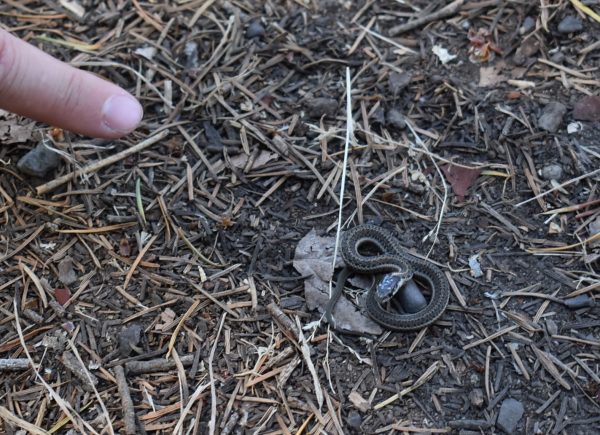
We found this wee beastie on Stuart Island close to the light house. Just a bitty baby garter snake, but so fierce!