When we bought Galapagos almost three years ago, she came with a lot of things. She came with great equipment, generous storage, a lovely salon, and a world class cockpit and hard dodger. She also came with an unfortunate smell. This was the kind of smell that caused people to turn up noses, look around for the offending issue, and to then look at us in that way that people do when their basic manners keep them from expressing their complete disgust. Boat people know that boats have smells and accept a certain level of stink as just part of the lovely experience. This smell, however, was beyond the pale.

Looking happy to get those old hydraulic lines out. Were they responsible for the terrible smell? They were not.
Although the smell has always been there, we didn’t exactly put up with this smell so much as fail to locate its source. From the first day we bought her we were both busy doing things that make an old boat smell better. We pulled all the old head hoses out and replaced them with pvc. We cleaned out the bilge, sterilized it, and painted it before the new engine went in. Recently Mike pulled the old hydraulic steering lines which we are sure had a small leak somewhere and replaced with with fancy new lines, keeping stinky steering fluid out of the bilge. We re-cleaned the bilge. We have replaced old cushions with new. And still, that smell remained. We’d think we had it licked, and we’d come down the next day, do a ‘smell report’, and find ourselves back where we started.
Clearly we needed a detective with a sensitive nose. Ordinarily I would call on Nancy Drew and her sidekicks Bess and George. I’m almost 100% positive that Bess has a bloodhound’s nose since she’s so sensitive in every other way. Between George’s athletic abilities getting into tight boat spaces, Nancy’s superior brain power, and Bess’ nose, they probably could have saved us loads of embarrassment. Alas, they have been busy over on my friend Ellen’s blog, solving the Case of the Missing Anchor. It was up to investigators Mike and Melissa to locate and neutralize the source of this smell.

This is the junction of the galley and the workshop, the area in question.
Let’s start with the clues:
One: It was not the head. Really. It wasn’t. Most people think if a boat has a bad smell, it must be coming from the boat toilet. In our case, that just wasn’t it. Our head does not smell. Even though the vented loop goes through the engine room, much to Mike’s annoyance, you can put your nose right on it and it does not smell. The cabinet where the tank is stored does not smell, either.
Two: It was ephemeral. That’s right, I was beginning to believe that the smell was actually a disgruntled spirit on the boat attempting to call attention to himself. It came and went in a way that made it very hard to pin down. Could it depend on wind direction? Temperature?
Three: It seemed to get concentrated in the cockpit, especially if the boat had been closed up overnight. When we approached the boat, which we do from the port side, we could begin to smell it. When we entered the cockpit, it seemed to be concentrated there until we opened the windows to allow air to flow through. Then you could still smell it but not nearly as strongly.
Four: When we would open the companionway cover, and stick our head down in the cabin, we could smell it but it would shortly dissipate after air was let into the cabin. We could smell it below but it was not as heavy, and mixed with the normal diesel smells from the engine room, it was hard to pin down the location. It was not present in the salon or the forward cabin. Nor was it present on the starboard side of the boat where the holding tank is located. The aft cabin sometimes had a whiff of it but you can also smell the engine room there. FYI, our boat lists slightly to port. Water will collect on the port side of the boat.
Five: It seemed worse during warm weather.

We want to be the boat with the fun cockpit, not the smelly cockpit. With Tate and Dani McDaniel and John Miller. Great times.
We began asking anyone who was friendly enough to come on board to tell us what they thought it was. After we got over the basic, ‘It’s the head.’ response and people paid more attention, everyone described the smell as ‘sulfurous’. It wasn’t the kind of sulphur you smell when you strike a match, but rather the kind you smell with hydrogen sulphide; kind of a rotten egg smell, but not quite. Still, enough people said ‘sulphur’ as they wrinkled their noses that we knew it was probably either electrical or organic. Mike ruled out the batteries and the anode in the hot water heater. The bilge is squeaky clean right now. You can stick your head down there and you won’t get that sulphur smell. You’ll get the smell of old fiberglass with only a slight whiff of eu de bilge.
Finally last week one of my clients who is sensitive to lots of things, including but not limited to people’s auric fields, ghostly visitors, etc, came on board for a coaching session. Turns out, her nose is awesome. Soon as she stepped into the cockpit she crinkled her sensitive little nose, and said, ‘What’s that sulfurous smell?’. Ahhhh. A ‘smells detective’ had dropped into my very lap.
Knowing a good resource when I stumble upon it, I engaged with her in that most primitive way: through the sense of smell. ‘Wander around the boat!’, I said, quivering hopefully. ‘Tell me what you smell and where you smell it!’, I said, opening the doors to the engine room. “Follow your sweet little nose directly to the source!”. I was positively expansive in my opening of cabinet doors.
She closed her eyes and sniffed, walking slowly on the port side of the boat, turning her head this way and that, stooping to investigate a space. She stuck her head in the engine room. ‘That’s just diesel.’, she said, dismissively. Standing in the area of the galley by the fridge, she spread her arms wide and declared the smell to be emanating from that specific area. We had our session, then retired to the cockpit to sniff further.

Just a really pretty little boat on the Foss Waterway. I can’t take a photo of the bad smell.
As an interesting aside, this person also sees a ghost on our boat. Apparently his name is Thomas. Fine by me. He seems a friendly sort and we may be able to use him on those long night passages where we get sleep deprived. Corporeal or no, I’ll take all the help we can get. During our session her eyes kept darting toward the port side of the boat. Upon my inquiry of what she was seeing there, she described a dark shadow in the air and asked if I saw it. Usually it’s Thomas she would be seeing, but this time it wasn’t. Well, I have to say that I did not see it, but then I don’t have the level of ‘gift’ that she does. Sulphur. Dark shadowy stuff. Brings up some pretty archetypal images, no? I wondered if she was seeing the smell visually. (Note: my client is not a weirdo. She is a professional woman who is intelligent and fun but sees many things other people do not. That’s sometimes a burden for her. I’ve known her for many years.)
Following her nose into the cockpit and then off the boat, she turned and confirmed that yes, the smell was coming from somewhere in the vicinity of the mid-port side of the boat and it was organic in nature. I thanked her nose for its service, said farewell, and stood staring at that side of the boat.
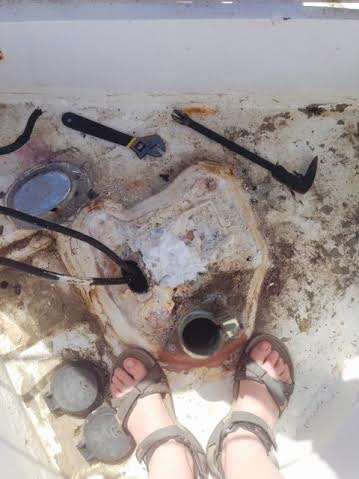
What could it possibly be? There is nothing ‘organic’ on that side of the boat. The fridge is fairly new and doesn’t leak. The cabinets in the galley do not smell. There was no plumbing on that side except for the deck drains. The grey cells began firing. The deck drains. That one deck drain that stood proud of the deck surface where no water would flow down into it; keeping it rinsed clean. What if?
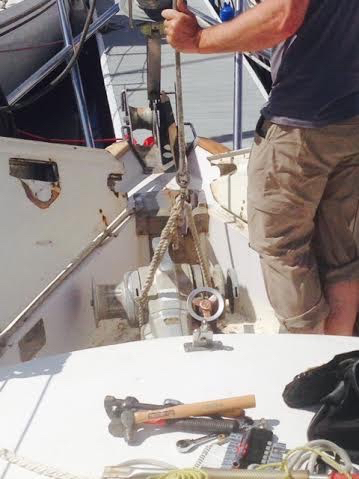
I leaned in, put my nose close and gave a big sniff. Bingo! Disgusting sulfurous smell! Maybe we had our culprit! And thus, that deck drain was taken out and replaced that very day. Afterward I mixed up some baking soda solution, took the hose and flushed fresh water down the drain, then followed up with the baking soda and water.
The next day I came to the boat and there was no smell. I stuck my nose in the drain and sniffed. It smelled fresh and just fine. Today is day three and still, no smell.

The starboard side of the boat where the head tank is located. No smell here. Thank goodness.
Time will tell if we have solved this case, but the prospects are good. We’ve never gone three days without smelling the thing. My hypothesis is that with the drain standing too high above the deck to do any good, organic material could still fall down into it, but would never be rinsed out. Likewise, some small creature could have gone up into the thru hull and died, then with no water coming in, his remains would have….remained. Seawater will be in the drain up to a certain point, and unless the drain is rinsed regularly, bacteria will grow and smell putrid, just as salt water standing in your holding tank hoses will putrify and smell bad.
Hydrogen sulfide is heavier than air, so it’s going to waft slowly. Our boat is almost always pointed into the wind in this marina, and the deck drain is slightly in front and to port of the cockpit entrance. The gas could easily get concentrated in the cockpit where it would have no way to dissipate and would then be drawn down into the cabin by way of the companionway door. Hydrogen sulfide gas is detectable to the nose in very small quantities. In large quantities it is dangerous. But ours was less danger than stink.
We’ve stuck our noses in every other drain on board, including the cockpit drains, and they are all fine. That’s the only one that smelled bad. So we are really hopeful that this is it.
Next time my client comes on board, I’m going to ask her about that dark patch in the air. Is it gone? If not, I’m going to need to hire myself a ghost buster.