Exotic Locations

The cruising life is fully upon us as we begin doing boat repairs in exotic locations such as Olympia and Jarrell Cove on Harstine Island here in the south Puget Sound area. When we last left you, we were taking a break from the boat yard, then heading to Jarrell Cove to rest and recuperate while we assessed the water damage to the bulkhead.

Taking a walk on Harstine Island

It’s really different dealing with this type of boat repair now that we are cruising full time. Gone are the days where we had two days a week for Mike to give his attention to the boat. In those days we packed as much action as possible into a day and then fell into exhausted, ibuprofen-laden sleep. We are learning a new rhythm now; a kinder and gentler rhythm on the whole. Instead of two days back to back of nonstop work, we only do one at a time. Then we complain about it. But seriously, yeah. There’s a lot less frantic activity so far.

After enjoying an extra day on the dock with our friends Stephanie and David Gardiner aboard S.V. Cambria, we finally took our leave and made way to Jarrell Cove, home of friends Rose and Gary Benz. Jarrell Cove is quiet and completely protected from most weather. Aside from friends, it also offers a state park with brand new docks that have electricity. We needed electricity for the next phase of project ‘Mizzen Mast Leak’.

Galapagos at the state park dock.

During a terrific visit with Rose and Gary, during which Rose served us her famous hamburgers with all the fixings (Thanks, Rose!! Yum!) our discussion turned to the aft cabin. Gary is a master wood worker and they also have a friend, Larry, who has many years of experience repairing and building boats. We made an appointment for Gary and Larry to come down and view the damage the following morning. Sometimes it’s nice to have extra pairs of eyes on a project before you start, just to make sure everyone agrees on the important things.

The next morning saw much interesting and informative discussion around the wood damage. There was head shaking, frowning, sighing, and many an expression of commiseration. But no matter how much we discussed the problem, no decisions could be made about how to do the repair until we actually got out the tools and removed the rotted wood. I was anxious to start cutting because I was worried about my beautiful painted fiberglass wall in the aft head. It backs onto that dratted bulkhead and I was worried it would have to be destroyed.

By closing the doors on either side of the cabin, we were able to isolate the work area.

Rose had found some heavy plastic for us (Again, our thanks.) and I hung a dust curtain in the aft cabin to protect our bedding. We rigged the shop vac up on deck so the exhaust was outside the boat and donned our masks. It was time to commence to cutting!

Mike and I take a ‘surgical’ approach to work that involves cutting nasty things like rotted wood and fiberglass. One of us works as the surgeon, wielding the cutting tool. The other works as the assistant holding the vacuum nozzle close to the action. We might be forgiven for being a little anal about keeping the floor swept of debris and vacuuming the area several times an hour. It makes clean up easier, and our beds stayed clean.

We got very lucky in many ways both during this phase and in terms of what we found. We had expert advice, we had electricity for the shop vac, there was only one other boat on the dock, and the noise from our shop vac did not disturb him. (Thank you so much fellow sailor!) We never want to be ‘those’ people who make all kinds of noise in a quiet place. So we really are grateful to the other sailor who didn’t even bat an eye at our shop vac and only expressed his hope we could get all the rot removed.

We found this tube in the cockpit lazarette. Is this a joke? We laughed and laughed.

With all the compromised wood cut away, we discovered another lucky thing: the 1 1/2” thick bulkhead was actually two 3/4” sheets of marine plywood glued to one another. The word ‘glued’ as it’s used here means that glue was applied to one of the pieces of wood. It has nothing to do with how much contact was made between said pieces. Therefore, by applying constant pressure with prybars of various sizes, were able to remove the outer sheet without damaging the inner sheet, then cut away the rot up in the corner and along the side of the inner sheet of wood. This is good news because now we will scarf in new pieces of marine ply, sealed with epoxy, to the inner piece of wood.

We’ll be able to cut the new piece to fill the gap left by the builders between the top of the wood and the cabin top of the boat, making that fit snug and tight. Then we will replace the entire outer sheet and epoxy/fiberglass it to the first, making a strong bond. Replacing this entire sheet means the new bulkhead will be a smooth surface with no obvious signs of repair. The new bulkhead will be much stronger than the old one. And it’s going to look good, too!

In the photo below, the top half of the wood that backs onto the engine room has been removed. This section, which is not structural, had more rot than the bulkhead. We got lucky, once more, in that the piece of marine plywood we removed from the bulkhead is big enough to cut a new piece for this opening. That saves a bunch of money.

Area with rot cut away. Notice gap at the top.

You can also see the gap between the top of the bulkhead and the cabin top. Guess the builder decided this was ok. It’s not. See those scratches on the wood? That was supposed to help the glued panels stick together. See how clean the wood is? That’s because those scratches didn’t do a blessed thing. There was basically a void in the middle between the two pieces of plywood.

Does this look like a man who knows how to use a circular saw?

All edges on the new wood and old will be sealed with penetrating epoxy. I have already applied penetrating epoxy to some areas that showed water staining but no rot.

At the end of the day, we feel lucky that the final bulkhead will be the same depth as the original, which means we won’t have to do extra finish work on the sole of the cabin and on the massive corner piece of teak that would otherwise have to be trimmed. In a nutshell, it makes the repair that much simpler. In addition, it means that my lovely fiberglass wall in the aft head can be left alone!

Lovely Jarrell Cove on a still evening. Before the rains came again.

We have until July 10 to finish this repair and so far we are very pleased with our progress. We are also pleased to be able to address each task of the project without feeling rushed and pressured, and still be able to enjoy being on the boat in exotic locals. This weekend is the Festival of Sail in Tacoma and we want some time out among the REALLY big boats. We’ll go anchor in Gig Harbor for a bit to address the next phase of this repair.

(P.S. – I’m experimenting with software that allows me to write blog posts while offline, then publish them when I get a connection. Some things, like the photos, are a work in progress.)

First, Leave the Dock

When people ask Mike and me what our travel plans are aboard Galapagos, we really have to kind of shrug, give a general overview of where we dream of going, and then we fall back on, ‘First, we have to leave the dock.’

Yesterday we did it. After 5 years of working toward this goal, this day where we would finally untie our lines and leave the marina and our land lives behind for awhile, this day that had loomed large and, sometimes, dark in my imagination, came and went the way all other days come and go. As just a matter of course. The time passed gently by, a sigh rather than a wail. It was a huge relief.

There’s our slip, empty as we pull away. It was filled about 2 hours later with the next customer.

Like all big life transitions, we did feel as though we should mark the day in some way. How should we do that? Should we have a party? Should we do some ritual spitting and whirling? Should everyone gather at the dock and wave goodbye? All of that seemed too much and not right, and we ended up doing nothing formal at all, which is kind of our style anyhow. And it turned out to be the perfect choice.

Friends Carolyn and Arlen and their dandy dog Monroe saw us off the dock and held the bow line just to make me feel better. Then they were there to catch our lines as we pulled up to the fuel dock. Friend Sam who works at the marina was there to help us fill the fuel tanks. In the end, with hugs and well wishes all around, we slipped away and into the placid waters of Commencement Bay, the whole world in front of us.

The lack of obvious fanfare does not mean, however, that we didn’t have some mighty fine omens in the mix. Mike and I learned to sail on Commencement Bay. We cut our teeth on those waters in our Catalina 27, Saucy Sue. Last year we joined a racing crew aboard SV Blue Moon. As we were at the fuel dock, who should come by but Blue Moon! They were going out for a pleasure sail and we got to say hello and goodbye to her captain and many of the crew we raced with last season. It was just so very good to see them all! I have really missed those Wednesday night races and the crew of Blue Moon very much. We learned a lot about sail trim last season, but mostly we enjoyed the crew and just being aboard with them.

As we pulled out into Foss Waterway, we passed another sailboat and Mike waved to Mike Rice, his sailing instructor from his ASA 101 class 13 years ago. I kind of wanted to pull over and let Mike tell his old teacher what he’s up to now, but we carried on, the symbolism of the  moment enough.

When you add to the fact that we took on only 108 gallons of fuel to fill the tank instead of the over 200 we had anticipated, the day was shaping up nicely and the omens for the trip were all to the good.

Farewell for now, Tacoma.

As we rounded Point Defiance going with the current, there was an eagle hunting the waters off the point, my personal talisman of good fortune when we begin any trip.  There were many seals in the water sending us off, as well as some harbor porpoises. What a day!

We made excellent time on completely flat, sometimes glassy, water down to Henderson Inlet, just north of Olympia. The engine chugged merrily, happy to be useful again. The cockpit cushions I made felt luxurious. I had zero anxiety. That was the very best omen of all. We dropped our new Mantus anchor overboard, it caught as we expected it would, I made the first entry in the log book, and now the first day is over and done. Just like that. Just like any other day.

Next stop, the boatyard. We’ll do a bottom job on our big girl, pull the mizzen and fix the leak underneath that, and probably tie up some other loose ends that are best attended to on the hard.  After that we plan to find a nice place to anchor in Gig Harbor for the rest of the month. We are really looking forward to that, for some reason. (Maybe that has to do with resting!) We like Gig Harbor, and being there for awhile will offer us a way to transition to this boat life and still have a few land based amenities, not to mention access to family and friends while we are still in the area. The tall ships are coming to Tacoma in June and we plan a couple of day sails out among the big girls with family aboard. You know nothing makes me happier than that. Unless it’s seeing whales. And that will be later this summer. Get ready, whales! Mike is practicing his whale calling songs!

So, we’re off. Phase one of Little Cunning Plan, Leave the Dock, is complete. On to phase two. Where will it take us? I guess we will see!

I want to take this opportunity to express our gratitude to our family and friends who have been nothing but supportive of this life transition. To a person, they have all helped us embrace the challenge, have supported us emotionally when things were hard, have offered to help when things were tough, have been proud of what we are doing, and have never, even once, tried to hold us back. This is no small thing. And this is not the experience many people have when they decide to go cruising on a sailboat. Thank you so much Claire and Andrew, Mom, Amy, Darin, Will, Reid, Jill, Dan, Carolyn, Karen, and Molly. Thank you for your support, for believing in us, for not thinking we are crazy, for knowing we have to do this now or risk never doing it at all, for all the reassurances that this will work. We love you all so much.

Thank you to all the many friends we have; too many to list here but you know who you are. Thank you for your kindness and support and your continued friendship in the face of our distracted lives. We know it must have surely looked many times like we were not paying attention. It means more to us than you will ever know that you continued to be our friends anyhow. And we will miss you all dearly.  We will pay your kindness forward in the world, to be sure. And we’ll be back.

Sometimes It’s Great to Be On the Road Again

We don’t generally talk about the costs we incur through travel here on the blog, but boy howdy do I have a surprise for you! Here’s a post with numbers that I didn’t even make up! (Although I did convert them to US dollars for your convenience.) During our trip to Scotland we traveled by land for the most part. This involves renting a car and this post is going to tell you how much that costs and why you need to just suck it up and pay it if you want to see the wild Scotland. Just going to Edinburgh, or any other city? Don’t bother with a car. It will be a nuisance and an inconvenience. Public transport and the ever-popular Uber is the way to go. But if you want to see the country, get a car.

Traveling back roads allowed us to get this tourist shot of the Blackadder River sign. Our blog name references a quote from that fine TV show. Our kids used to know all the lines verbatim. Impressive.

If you are like the majority of U.S. travelers, you’re going to reserve your car in advance on a discount website such as Expedia. Go ahead and do that because, why not? On the website it’s going to tell you that for 21 days of rental, you’re going to pay less than $500 for the car. That will give you good feelings as you read the part about your costs differing when you pick up the car. Don’t worry. They will differ. A lot. And you’ll pay it because you want to see the country you are visiting and this is the best way to do it.

I reserved an automatic, mid sized vehicle on Expedia through Europcar. Fortunately for me, this was not my first car-rental-rodeo in Scotland so I already knew the drill. You reserve the auto of your choice, then you cross your fingers and spit three times while spinning as you wish fervently for an automatic transmission. That’s because you’ll find that even if the website says one is available, which it won’t as a rule, you will know not to count on that. Why do you want an automatic? We’ll get into that later.

Our road trip included a spur-of-the-moment side trip to Scone Palace.

When you get to the airport, you will confirm with the nice man behind the counter that you have reserved an automatic, at which point he will frown sadly and tell you that alas, your car is a 6 speed. All the cars are 6 speed in Scotland. Except the automatics, which are few. You will politely point out that this is not what you reserved, reflect on your quickly aging knees, and ask worriedly if there is anything else available at the same cost, since you actually called Europcar’s international number to be sure that you did, in fact, have an automatic on hold. Then he will offer you a Mercedes 22S Estate wagon that was ‘just turned in’. He will give you all the discounts and you will say yes to paying what you think is $19.31/day for the use of that car, smiling broadly.

Once you have your car, you will be presented with all the insurance choices. This is where the rubber meets that old proverbial road you’ll be driving on, the one with only one lane and ancient rock walls on each side where the posted speed limit is 60 mph. (Yes, they use MPH in Scotland. But they sell their fuel in liters to confuse us and obfuscate the fact that you’ll pay about $6/gallon for diesel fuel.)

Your insurance choices will be grim. A cool extra $32.18/day (!!) will allow you to walk away from the vehicle Scot free, as it were, should any little thing happen. Hmmm. I’ve driven extensively in Scotland. So far, in spite of other North American drivers on the road, I’ve turned all the cars in unscathed. I think I’m a good risk. That highest covered amount also comes with roadside assistance should we get a flat tire or whatever. It was tempting but our wallet protested and we know how to change a tire.

Driving through the Cairngorms. In a car.

Due to our basic faith in our own abilities to handle situations and to drive carefully, we chose the lowest insurance option of $21.45/day. This got us a $1673.49 deductible. Gone are the days when we would just fork over the extra $225 for the best and easiest insurance and be done with it. Le sigh.

If you’ve kept up with the math here, so far we are paying $405 and change for the vehicle, and adding on $450 ish for the insurance. Our bill should be $860, right? HAHAHAHAHA! In your dreams, sweetie.

Now you must add in $346 for the basic rental fee. I think this must cover just your basic 6 speed tiny car. It’s also a little annoying because, as referenced above,  I understood that we were paying $19.31/day for the vehicle. In fact, that was what we were paying for the upgrade, which I had already reserved and thought I had the cost nailed down. I chalk this failure to understand up to our being exhausted after about 24 hours of travel, and the sales person’s strong Glaswegian accent, of which I could understand about 1/3. Oh well. We would have had to pay it anyhow. Now our bill is up to about $1206.00.  But wait! There’s more!

You’ll pay 20% VAT on that ‘purchase’ as well. Plus a license and fees charge, plus a ‘premium station surcharge’ that tacked on an additional $112. That must be for the convenience of picking up the car at the airport.  All in with all the taxes, fees, etc, the bill came to $1630.00.

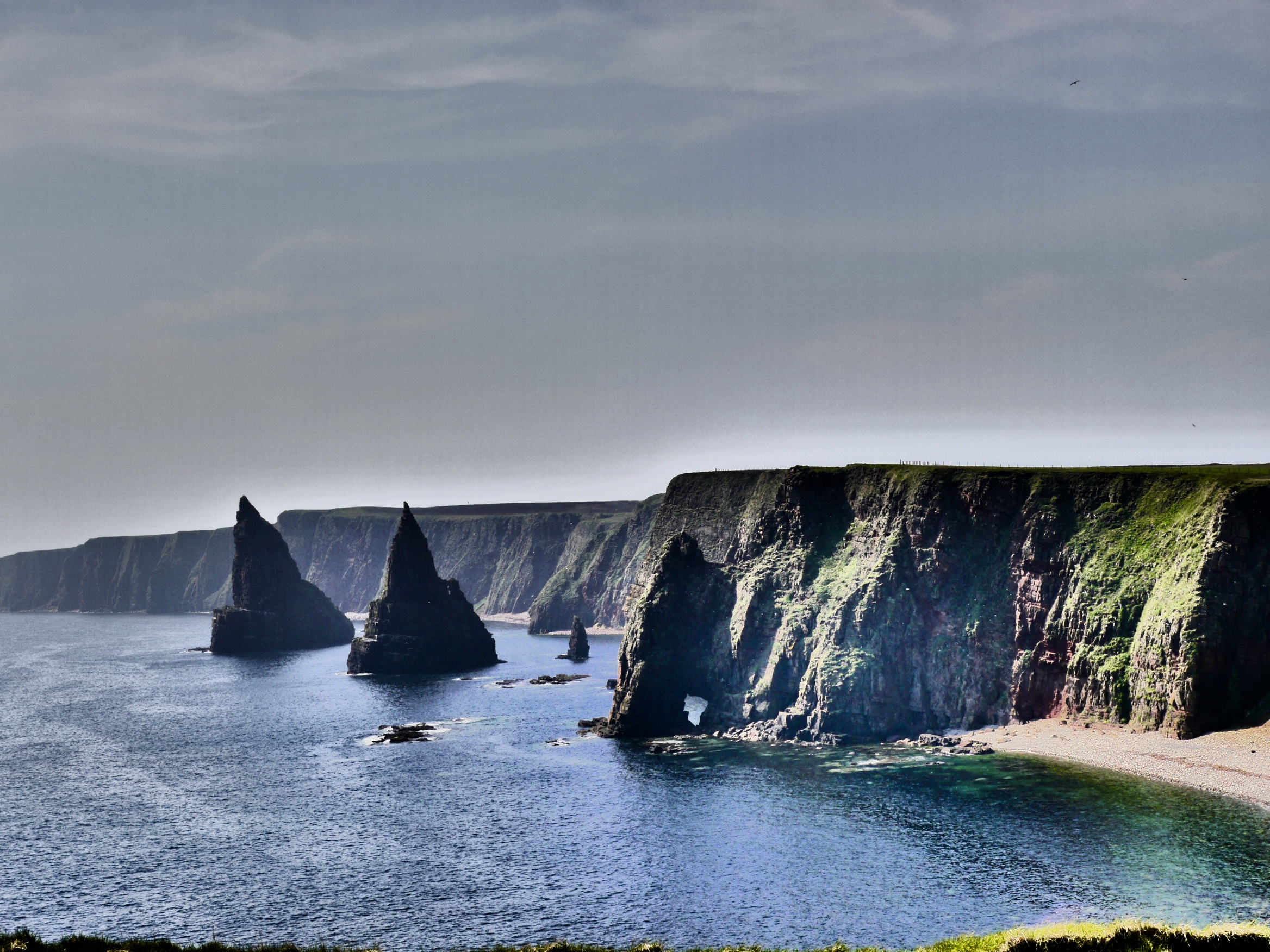
Off Duncansby Point.

We put about 1400 miles on the car, so that’s a little more than 1$/mile we paid just for the privilege of driving, not including fuel. It’s a steep cost, I’ll tell you, especially when there are no more fat paychecks coming in and you have a date with a guy in a boatyard coming up.  But we wouldn’t do it any other way in Scotland. There are just too many narrow roads to go down where taking public transport will hold you back. This is the price of freedom, of spontaneity. It ain’t free, you know.

And just a word about that VAT. It’s easy to get your United States knickers in a twist about a tax that high. But look at it this way: if you travel in Scotland you will never lack for a place to use the potty. These people are great with their clean, well appointed public rest rooms at the center of every town, no matter how small. Also their roads are in pretty good shape considering. Even the small roads are easy on the car, with very few exceptions. They also have excellent signage, even on the tiny roads.  I’m not actually going to complain about that tax. Roads and bathrooms cost money.

Now that you have the car, you’ll want to understand the road system. There are three common levels of ‘highway’ roads in Scotland: M, A, and B. It’s easy to know that M stands for ‘main and most convenient road’, the M8 for instance. A stands for ‘alternative and possibly more scenic route that reasonable people can take’. We drove on a ton of A roads as they go through all the small towns and the countryside. A nice A road is a pleasant experience.

Sometimes you just snap a photo from your moving car. This is an A road.

The ones to be aware of are the B roads. B, as used here, stands for ‘Scares the Bejezus out of you’. These are narrow, one lane roads that are widely used and can have speed limits of up to 60 miles per hour, which some people think is an appropriate speed at which to approach a blind curve with rock walls on either side. These roads are fraught with blind curves, blind summits, and Scots who have been driving them for hundreds of years. It’s in their blood to drive these roads, but it’s not in yours, or, at least, if it is it’s well watered down. Take extra care and keep the brake pedal handy.  These are the roads where you will bless that automatic transmission because it gives you one less thing to think about. Also your knees will not get tired from the constant shifting. I know this because the first trip I had to Scotland, I drove a 6 speed. The fun wears off quickly.

These roads have ‘passing places’ where people pull over to allow others to get by, at least when they are following the rules. You will learn very quickly to look as far ahead on the road as possible on these roads; about 20 feet or less generally. They give your adrenal system a good workout as cars approach from the opposite direction across a narrow bridge, at speed. These are the roads you should keep in mind as you choose your car. The smaller the car the more pleasant that B road driving experience is going to be. But I never saw a really small car that was an automatic. You’ll have to choose your poison.

The final consideration will be the roundabouts. They are extensive. They can be huge, with many lanes, encompassing large territory and multiple exits. They are, simply put, heart stopping. On the other hand, they are generally clearly marked. Even on the actual road, in each lane there will be signage indicating which exit that lane is for. They do the best they can. The rest is up to you. Stay in your lane. Use your signal. Watch out for other drivers from almost literally everywhere else in the world where they drive on the right. If you are so inclined, pray. If not, feel free to curse. And remember, if you miss your exit you can always go around again. The other drivers will hate you, but it can be done.

Renting a car allowed us to see some of the most beautiful countryside in the world at our leisure on our own time schedule. It’s kind of like having a boat. It’s a damned expensive way to travel, but we wouldn’t do it differently.

Oh yeah, we turned that car in unscathed.

And guess what, guys? We left the dock today. See you out there!

A day of regular Scottish weather in the Grampian mountains.