Rainforest Adventure: Getting There

Ahhhhh. We are sitting here in the fantastic Hotel Reina Isabel in Quito for the last few days of our trip, enjoying luxury and good wifi. After 12 hours of travel by canoe, small bus, then smaller bus through the Andes mountains yesterday, we need a day of peace and quiet, laying around doing nothing but writing posts and resting. This is just the place: Comfortable king sized bed with duvet, large open corner room on the 4th floor above the noise of the city, huge bathroom with large separate glass and tile rain shower and a real Jacuzzi tub, plenty of hot water to fill the tub, completely responsive staff who all speak English (wow!), a turkish sauna, and a breakfast that puts our country’s hotel ‘breakfast included’ places to shame. Now the number everyone wants to know: we paid $204 total for three nights here, including breakfast. We booked through Expedia and I’m pretty sure that’s how we got that price because the posted price is much, much more. If you book through the hotel website, it’s also more. We love this place. Can we live here now?

Yes, it’s as comfortable as it looks.

We’ve just spent 5 days in the Cuyabeno Wildlife preserve at the Bamboo Ecolodge. The term ‘ecolodge’ as used here means one step up from Gilligan’s hut. It’s completely off grid in the middle of the jungle. But I’m not complaining. It’s fantastic. This is the first of a few posts about our rainforest experience. I’m getting all of this written down in case anyone else wants to channel their inner Professor or Maryanne and travel here.  Getting there is half the adventure.

There are 14 eco lodges along the rivers and lakes of the Cuyabeno Wildlife preserve. How did we choose Bamboo Ecolodge? I used the time honored method of going with the cheapest place we could find and liking the website, which is the internet equivalent of how I choose wine: by how much I like the label, all other things being equal. I know nothing about wine or ecolodges. My research showed that all of the lodges in the reserve offered exactly the same kinds of tours and activities: canoe rides on the jungle river, night walks in the jungle with flashlights looking for bugs and frogs, caimen lizard spotting at night, swimming in the lake with the piranhas,  early morning bird watching, a visit with the local indigenous Siona community complete with Shaman viewing and manioc bread making, certified personal guides for your group. Same boats, same rivers, same animals, same Shaman and bread baking.

Our room is on the bottom floor.

Here’s the rainforest experience in dollars: We paid $872 for a ‘matrimonial suite’ room and all inclusive tour of 4 nights and 5 days at this lodge. (Add another 50$ in tips to the guide, cook, housekeeper, and boat captain.) What we got for that money was the guide (Diego, The Great), a private room and bath that was separate from the other guest rooms and had walls that came up to the ceiling (unlike the other guest rooms which afford no sound privacy at all), all meals and fresh water to drink,  electricity from 6pm-10pm, and private transportation back to our Quito hotel. Read my Trip Advisor review here. One of the more popular lodges, the Cuyabeno Lodge would have charged us $1100 for their deluxe room. I don’t know the status of their walls and whether they afford privacy between spaces.  If you are ever in the position to do a rainforest tour here, do your shopping around and book directly with the lodge. The prices for lodges on websites such as Trip Advisor and Expedia would lead you to believe this kind of travel is not affordable. We feel like we got a good deal at our lodge and we had a very good guide. We also got lucky with our group. There were only 7 people in our group and they were all respectful and friendly. That was fortunate.

Getting to the Cuyabeno Wildlife preserve is an adventure in itself and the planning of this part of the trip enlightened me as to why people just go with tour groups. All the logistics of planning the connections can get very confusing and overwhelming. From Cuenca, we took a plane to Quito and stayed in the Quito Airport Suites Hotel for 39$, plus 16$ round trip to the airport. That’s a lot by Taxi standards here. You are paying for the convenience.
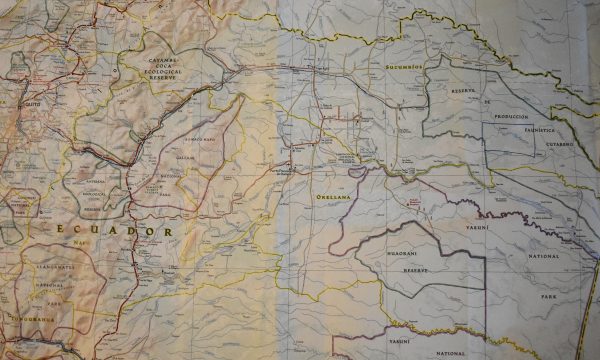
On this paper map you can see the area we explored to the right, in a rectangle I drew on the map. The road to Quito is marked with pen. Wish we had a marker in this hotel. Alas.

This place is owned by an American and is a fine place to spend a night if you have to be at the airport the next day. The cook will make lunch for you for a modest fee if you need it and the food is good. We have found that to be the case almost everywhere in Ecuador at the smaller hotels. The kitchen might be closed but if you are hungry they will cook for you. I would say the website makes this place look more upscale than it is,  but we were happy enough with it and the owner is a nice guy who we enjoyed visiting with. There’s a great yard to sit in and read and watch birds and visit with the other guests. It’s located in the ‘town’ of Tababela, but in reality this is a very rural area and I thought our driver had made a mistake when he first pulled up to the motel.  I’m kind of wondering why we were not offered the January special of free airport pickup, but it’s only 8$ and relieved a lot of stress.

From Quito we flew to Lago Agrio, the meeting place for the rainforest tour. Lago Agrio is an oil boomtown and driving through it we found we were glad to not be staying there. The lodge offered private transport from Quito to Lago Agrio, but we declined even though the price was right at 25$ per person for a 7 hour bus ride. The bus would be traveling through the mountains overnight and this did not sit well with me. The road between Quito and Lago Agrio is a narrow two lane highway that literally snakes its way up the mountains. As we found out on the way back during the daytime, it is a rough road with a lot of bouncing around. Unlike our mountain highways, there are no straight areas in the road for more than 30 seconds before you are doing another hairpin turn. By the way, the bus had pretty much no suspension.

On our way back we saw there are NUMEROUS areas where the road is washed out due to the heavy rainfall. The common repair is to add river rock and dirt and then drive over that. Vehicles need to take these areas very slowly.
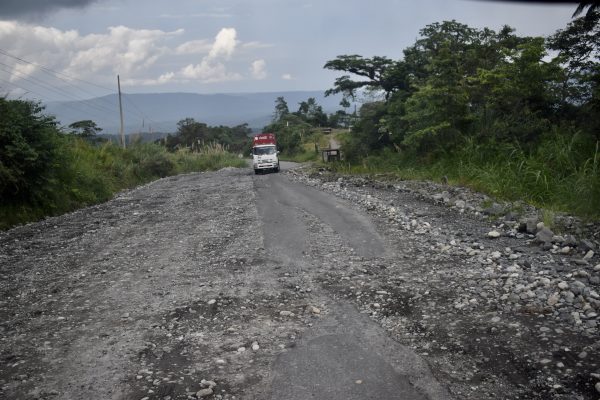
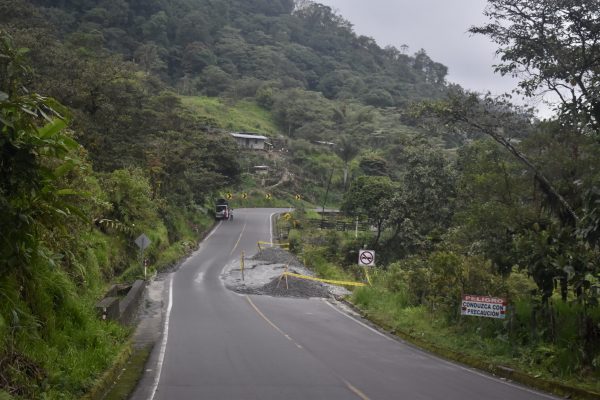
Two of the extremely common washed out areas of highway along the way from Lago Agrio to Quito.

Many places on the road have no guardrails and add to that the heavy truck and bus travel, all trying to pass one another on a blind curve. We have a friend who lost her beloved 16 year old daughter to a bus accident at night in Bolivia because the driver was tired and fell asleep at the wheel, plunging the bus off the side of the road. Recently Peru saw a bus accident in the mountains that killed 48 people. In addition, I knew that we would get no sleep by traveling overnight and I wanted to be well rested for our tour the following day. We paid more for peace of mind and a good night’s sleep and I know we made the correct choice.

At Lago Agrio we were met by a taxi arranged by the hostel we stayed outside of the town: Planta Azul. I’ve always wanted to see my name on a sign held by a driver at the luggage pick up at the airport. For 5$ I got my chance. “Ingrid – Planeta Azul” , the sign said. Damn it. Wrong name, right ride. We got in the car.

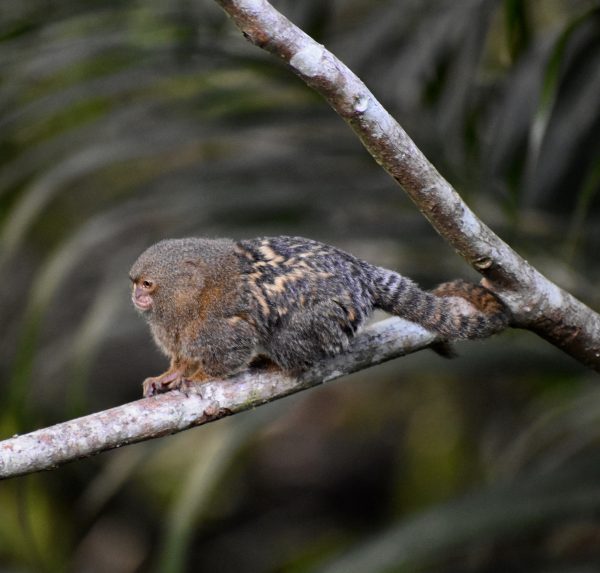
Planeta Azul is the meeting place for all of the eco lodges in the area. It’s right by the little suspension bridge you can see from the plane when you begin to land in Lago Agrio.   Once more we had arranged to have a room with a private bath by asking specifically for such a room. Thank goodness because all the rooms are on the second floor and the bathrooms are downstairs. Traipsing down dark stairs in the rainforest in the middle of the night with only a flashlight for company? Nope. In order to book this room, we had to go directly with the manager of the hostel. Although the lodge is listed on Air Bnb, you cannot reserve a specific room that way. I contacted the ‘owner’ through that website and then I went directly through ‘Betty’ and paid her cash on arrival of 30$ for a room on the balcony of hammocks where we sat and watched Pygmy Marmosets and Black Mantled Tamarins all afternoon. It was pretty awesome, I have to say. This place also has a lovely swimming pool for guests. I made good use of that.


Cheeky Black Mantled Tamarin
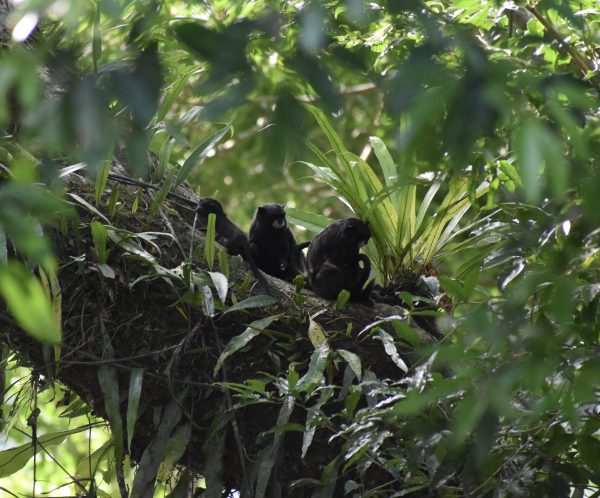
Three little monkeys sitting in a tree.

In the morning after breakfast several private vans showed up and all of the guests divided up according to their lodge destination. It would be a two hour bus ride to the Cuyabeno Reserve bridge where we met our canoe and had one final opportunity to purchase snacks, which we did, and for which we were glad many times. These ‘canoes’ are more like stretched out fiberglass pangas to us. They are very long and wide enough to be stable. The canoes are all owned by families of the indigenous people who live in the rainforest. The lodges are not allowed to own them. They rent canoes and drivers from the tribe, which allows the tribe to make money. It’s a nice system. Eco tourism is the life blood of the rainforest at this point. It protects the rainforest and also the people who live there.

The Pygmy Marmoset. Be still my heart. I am still incredulous we spent all afternoon watching these little creatures.
 True to the name ‘rainforest’ our first ride through the forest was in literally pouring rain. There’s a reason why the lodges give all guests heavy rain ponchos upon arrival at the bridge. Nothing makes me appreciate our hard dodger on Galapagos more than going 20 knots in stinging rain. I’ll leave you with some notes on the canoe ride written in my travel journal:

“I had some silly idea I would be able to take photos during the boat journey. Other people thought this as well. But on this day, I regretted not buying that expensive Nikon waterproof camera I looked at last year. My camera is NOT waterproof. I spent most of the canoe ride with it huddled underneath my heavy rain poncho like a hen sitting on a precious egg, hoping to keep it dry. Lesson number one: buy a waterproof camera if you are going to the rainforest.

We are kind of excited for this boat ride. The river runs fast through the rainforest. It’s narrow and muddy, and there are a lot of snags and fallen trees in the water. But that is nothing to our driver. He starts the Yamaha 20 hp twostroke with one strong pull and roars downstream. Whee! The boat jumps to life and the driver slaloms down the ribbon of brown snaking through the jungle, throwing bow wakes to the left and to the right. I look at Mike and yell that I’m waiting for him to hit a snag in the water because there are many of them. I have a cunning plan for getting to shore should he turn the boat over in his attempt to catch air with his hull. But apparently he knows this river really well. As we approach a likely snag, he puts her in idle and lifts the engine out of the water. We coast over it and roar on.

As it begins to rain even harder I am ducking my head to keep balls of water from slicing through my eyeballs. My glasses act as a windscreen, but I cannot see a thing. The water is warm enough to fog up the lenses. I pull the hood tight against my face to keep water from getting to my hearing aids. I’m already planning what to do differently on the ride back. Mike is blissfully sitting there without his rain poncho, soaking wet, gleefully bailing water out of the bottom of the boat with a large rubber boot, glad to be back on the water again. He grins like the primate he is. He has his waterproof camera. (Addendum: he would live to regret this life choice as his leather hiking boots have never dried out and his leather wallet grew a layer of fine, dusty mold. Neither did his clothing dry completely while we were there.)

It’s hard to see anything this way.

During breaks in the deluge our guide raises his arm to signal the need to stop to view animals. We observe Spider Monkeys, Toucans, Tree Bats, some big Morpho butterflies. We are having the time of our lives. Who wouldn’t want to scream down a muddy river at 20 knots, swerving left and right to avoid snags, rain pouring in solid sheets from the sky? During one pitstop for animals thunder cracks directly over our heads. I practically leap from my seat I’m pretty sure I’ve never been that close to thunder. Our driver takes off, streaking down the river. Mike said he was trying to outrun the storm. I’m pretty sure he was just having fun.

After almost two hours, the river widens into a large lake and soon our driver is beaching the canoe onto the mud. It’s still pouring rain as we get our luggage and trudge the very muddy path, a swamp, really,  up to the lodge. Mike and I had reserved the extremely fancy ‘Matrimonial Suite’, which means we have two beds and a bathroom all to ourselves. It’s awesome. We can’t wait to begin.”
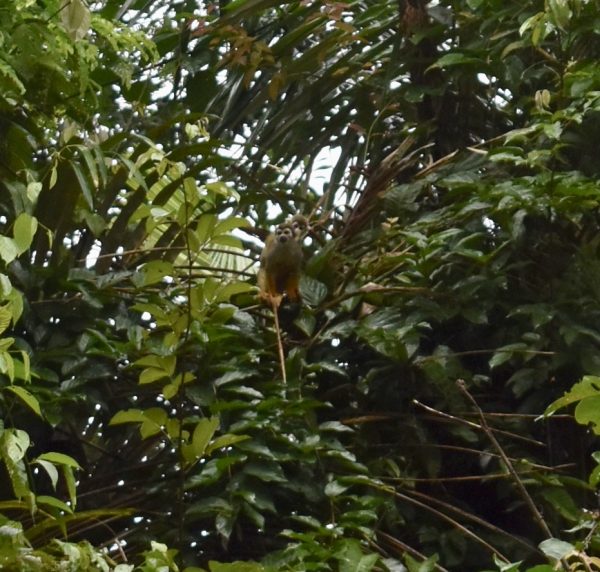
A real live Spider Monkey.


Ten Things to Know Before You Go

It’s time for the New Year’s reflection post.  2017 was the year we made the break from our comfortable middle class home and moved onto our sailboat. It was the year we cut the dock lines and began cruising full time. Many of our readers are gearing up for their own shift to a cruising lifestyle. They pour over the Yachtworld listings, going down the rabbit hole of finding that ‘perfect for them’ boat. They are reading and following all the cruising blogs and vlogs out there, wondering when they, too, will be sitting in the cockpit with sundowners and friends, a warm and gentle breeze ruffling water. If you recognize yourself in this description, read on. What things have challenged our fun/suck ratio? Because you know we are only going to be doing this as long as it’s fun.

How I loved seeing these Elephant Seals and listening to them grunt at night from the starry-skyed cockpit.

I’ve made a list of what I consider ‘reality checks’ just for those of you who are in that position now. Some of these are not big things and, frankly, I had trouble coming up with 10 of them, but when you are cruising even small things can matter a lot.  I don’t want to burst any bubbles, but it’s useful to know some of the realities so you won’t be disappointed by your own fun/suck ratio.  Recognize, as you read this, that if your cruising grounds are different than ours, your mileage will vary. Cruising down the west coast of the United States is much different than doing the ICW, or cruising to the Bahamas from Florida. Many of these points will be moot for cruisers in other locations.

  1. You’re going to get really physically/mentally/psychologically tired. Reflect, if you will, on the idea of visiting 27 different ports and anchorages in 3 months.  In each of those places we had to figure out the logistics of being there: where it was safe to anchor, how to get ashore safely and securely, where to leave the dinghy, where we were in relation to things like stores and fuel, or even places to walk, what sights we might want to take in, whether it would be safe to leave our boat unattended.  This is part of the fun of cruising, it’s said. It’s part of the “adventure”. What is less said that I’m going to say right now is that this is bloody exhausting. There’s such a thing as ‘too much fun’ and after about the 20th place, the fun starts wearing thin. It’s important to note this if you are planning to cruise, especially if you are going to cruise down the west coast of the United States. This is probably why some people just zip down the coast in one or two passages. We wanted to see what California had to offer. We don’t regret the choice at all because we had a ton of fun and saw wondrous things.  But it’s important to note that you need to allow time for rest and recovery or people are going to start to get cranky. That leads to…

    Such great bird watching at Pebble Beach.

  2. Take breaks from the boat. Just go ahead and plan them in advance because the need for a break sneaks up on you. By the time we got on the plane to Ecuador, we really needed a break from boat travel but were just beginning to realize that was what was wrong. Tempers were getting shorter than in any time in our marriage. Communication skills were being challenged in ways it’s impossible to predict when living a shore based life. People will tell you that cruising will challenge your relationship, but the ‘how’s’ of that challenge are so intangible that it’s hard to put them into words. Certainly being together 24/7 would challenge anyone, but it’s more than that. Frustrations are more poignant and unless you want to fight a lot, you better learn to handle your frustrations yourself. Decisions are more important and carry more emotional weight, not to mention physical safety weight.  Weather is always on the front burner, as is boat movement. Both of those things will take precedence over your irritation or hurt feelings. There are physical and psychological demands that require physical, psychological and emotional energy to deal with on a constant basis. If the power structure of your relationship is a fairly egalitarian one at home (which ours is), that’s going to change some because there is only one captain on a boat at any one time, especially when the chips are down. So that creates a lot of opportunity for you to become humble and question the wisdom of what you have chosen. Put your breaks on the calender, just like you do your vacations back home.

    Monterey Bay was a favorite place.

  3. If you love anchoring out like we do, that’s going to add to your stress in some ways. Until we pulled into Cruiseport Marina in Ensenada, we had stayed 8 nights at a dock since September 1. That’s less than 10% of the time. We consider the idea that maybe we are too avoidant of marinas. Perhaps we aren’t doing ourselves any favors by being the stolid anchor-outers that we are. We’ve considered that we might stay in a marina one or two nights per month as we cruise in Mexico, just to have regular breaks and easy access to land. We’ll see how that plays out. We’re kind of stubborn about wanting to be independent of land as much as possible, and marinas eat through our money faster than anything else. Want to know how to save money while you are cruising? Don’t stay in marinas.

    Entering San Fransisco Bay after our first multi-day passage was surreal. Still is.

  4. Don’t quibble about buying a water maker like we did. Regardless of your tankage, just get one while you are employed and bringing money in regularly. We carry 300 gallons of water, which sounds like it should be plenty. And it is! But I am constantly aware of how much water we use, even though we are really good at conserving it. It’s a constant nagging stress for both of us that impacts the enjoyment of this life we’ve chosen. Here’s why this snuck up on us: if you are in the United States you are used to being able to pull up to the dock, put a hose in your tank, and fill up. We have good clean water for the most part in our country. So we assume that when a marina advertises that they have ‘water at the dock’, they are referring to POTABLE water at the dock. And this is where that assumption is incorrect. Even though we read a lot about cruising in Mexico and water being available, we didn’t connect the dots that MARINA water is not necessarily potable. So that means that you have to pay someone to bring water to the boat and pour it into your tank. Or you have to lug the jerry cans yourselves to do that. Here’s the rub: we don’t actually want to live that way. Sure, we are capable of it. But it’s not how we want to spend our time. And it doesn’t make us feel like we are able to spend long weeks away from infrastructure where we can get potable water. So at some point, if this cruising thing goes on for more than a year, which I’m guessing it will, there will be a water maker on board. And it will be the kind that is easy to get parts for.

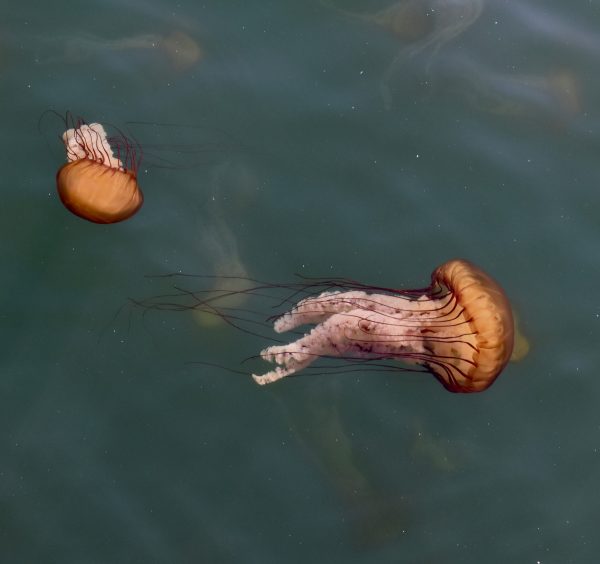
    We came back to the boat one day surrounded by hundreds of these Lions Mane jellies. Monterey Bay.

  5. The common wisdom among boat cruisers is that this life is filled with highs and lows. Hmm. Okay. Fair enough. But here’s a thought: in day to day life on a boat, it’s actually the differential between perceived danger and relative safety that create most of these highs and lows. On a boat the differential between safety and potential danger can happen regularly, sometimes more than once in a day.  For instance as we traveled in the Channel Islands in California, we were often met with high winds and the accompanying gnarly seas that were not only uncomfortable, but took all of our skills to navigate safely. During those times there is acute focus. All the senses are on fire in order to keep the boat, and us,  out of danger. Those were lows. (Although for some folks they may have been highs.Those people probably enjoy things like bungy jumping and sky diving, too.) After we’d negotiated those conditions successfully and found a safe haven, we got such a feeling of relief that the differential between the two states could have been perceived as a high. But in reality we had just returned to a normal, average state of being.  It wasn’t like dolphins swimming off the bow, or seeing night creatures in the water, or swimming with a sea turtle.  It was just relief. Maybe this is what people are referring to as a series of ‘highs and lows’. For me, the true highs are those things that do not happen every day. By their nature, life’s ‘highs’ are rare things. Unless you are going to sit in a marina most of the time, your’re going to start understanding this part of my post pretty quick once you are away from the dock all the time.  Your adrenal glands will get a workout in this way of life. And that leads to more need to rest. Don’t begrudge those sailors who sit in the cockpit and drink their sundowners after a hard sail. They’ve earned it.

    Challenging and beautiful Santa Cruz Island, with good friends on S/V Blue

  6. Here’s one for the people who just do not LOVE cooking:  When you are planning a cruise, a lot of fuss can be made about how one cooks in a galley. I was guilty of getting into the drama of worrying about cooking in a galley, even though I had already cooked a lot of meals on our summer cruises. Why is this? I think it has something to do with wanting to be as prepared as possible. And also I needed something to feel like I had control over when Mike had control over most of the boat systems. But here’s what galley cooking boils down to: it’s pretty much the same as cooking anywhere else. That’s it. Sure, there are special items like a solar oven (which we do not have) that some people use really nicely on their boats. And there is stuff like making beans or rice in a thermos, which works pretty well. If you are really into cooking you might want to explore those kinds of things.  But at the end of the day, ask yourself how you cook at home. Because that’s probably how you are going to cook on a boat. If you are worried about conserving propane, get additional tanks and keep the extras filled. Propane is the cheapest thing you’ll be buying on a boat. Give yourself a way to cook outside the cabin if you are going to be in hot places, like having a grill on the rail. If you are the kind that makes full meals in a pressure cooker, you’ll probably use it on the boat as well. If not, well so far, mine has looked lovely sitting in the cabinet by the sink. Same with my thermal cooker. I’ve used it only a couple of times.  The one-stop-shopping resource you should have is The Boat Galley Cookbook. There are recipes, but mostly there is information about different ways to do things for those of you who like to tinker in the kitchen.

    I never get tired of snorkeling.

  7.  Every single penny you spend on making the interior of your boat comfortable and attractive is worth it. Just do it, if you can. I remember feeling somewhat guilty that we would spend money on things like paint or colorful, comfortable pillows for the boat interior when we needed to be spending money on engine parts and the like. Safety first, right? As I sit here, however, I do not regret one penny we spent on those things because this is not a vacation, this is our lives. This is how we live, at least for now. And referencing my comments above about the ‘highs and lows’ of cruising, having comfortable berths to tumble into, or an attractive salon that feels welcoming goes a long way after a long day of working with the sea.

    Galapagos is WAY down there. Catalina Island.

  8. If you are planning a trip down the west coast of the United States, go ahead and join the cheapest yacht club you can find that has reciprocal privileges. We didn’t do this and it would have made a big difference in our trip. Friends of ours pulled onto docks regularly because of those reciprocal privileges. Especially if you are not a consummate anchor-outer, join a yacht club.  California is all about yacht clubs in a way we did not predict.

    When you spend time in the salt water, you also use more fresh water because you must rinse everything off.

  9. You might be very bored. Yes. There. I’ve said it out loud. Cruising has long periods of time where you might have nothing to do unless you really, truly want to get out the sandpaper and get to that greying teak or take up guitar or bake something that you don’t really need to be eating.  We read. A lot. It takes a long time to get used to all the downtime and figure out what to do with it. I’m so used to having a focus; a goal, a project.   Mike always has some kind of boat project he’s working on, but I do not. I have my art supplies on board but have yet to get them out. They make such a mess when I do and I hate it when the boat is a mess. The things I used to fill my time with at home (called HOBBIES) are not things that translate well to the boat so far. But I’ll find my groove with it eventually and I’m not complaining that I have so much time to read. I’m remaining open to discovering new interests at some point. Just don’t be surprised if you get bored. I think of the boredom as an opening for inspiration that just hasn’t hit me yet.

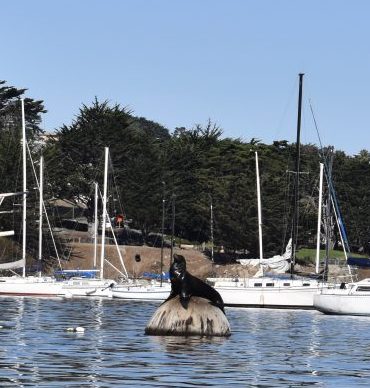
    I wonder if this sea lion deals with boredom. Likely not.

  10. Going south from Washington has meant that we have sunny days, but the sun sets early, a rhythm we have not quite got accustomed to. After 31 years in Washington State, our bodies do not understand how the sun comes up so late and goes down so early, and yet the days are sunny and warm. Isn’t it summer? Isn’t the sun still up at 9:00 pm? No?  Go ahead and buy those cockpit lights and make sure you have good lighting in your salon. We should have invested more in cockpit lighting.  You may not need them up north, but as you move south you will. And while you’re at it, get an anchor light that comes on automatically when the sun goes down; maybe some reflective tape for your mast. You’ll never need them up north, but you will down here. The nights are long all year round closer to the equator. That’s not a bad thing, but it’s worth noting. Along with this you can expect your biorhythm to change if you are accustomed to a more northern latitude. We go to bed so early it’s kind of eerie. I probably haven’t had this much sleep since I was 5 years old and forced to take naps. It goes something like this: “I’m so tired. Time for bed. What? It’s only 7:30? Damn! Now what? ”  I’m starting to think this is why some sailors drink a lot.

    A favorite view of the full moon taken from our view on the sea.

Taking these things and others into consideration, the fun/suck ration for us is definitely on the side of ‘fun’ so far.  We are happy doing what we are doing for now. We would never in our wildest dreams have encountered Elephant Seals on the beach, or a sea turtle swimming just beneath us, or any of a hundred other things we’ve experienced had we not been traveling by boat. We’re even glad to have had some of experiences of the ‘low’ times, because we’ve mastered those and know we can handle them now.  But with so many blogs and magazines making this lifestyle look like an unending vacation, you can count on Little Cunning Plan to give you the rest of the scoop. It’s not a vacation. When you go on a vacation, you leave a lot of the everyday concerns of your life behind for awhile. When you go cruising, you take them with you and have to deal with them in a completely different way, plus some. Being mentally prepared for some of the challenges this lifestyle brings with it will go a long way toward making your cruising life a success for you.


Those TIPS: Temporary Import Permits

This will be a test post from the land of slow interweb connections. Yes, we’re in Mexico. Didn’t see that coming, did you? We took the plunge and decided to leave early Thursday evening so we could get to Ensenada early in the day today and get cleared in before the weekend. We are starting to feel a little rushed as we have a plane to catch to Ecuador on December 7 and we would like some time to get the boat buttoned up. So here we are in Cruiseport Marina, and you won’t have any photos in this post because: slow and unreliable internet. What an interesting place this is already.

Let me be honest here: I’m having a number of what I’m going to call ‘American Moments’.  I’ve decided that term aptly describes the assumptions that I, as an American, make about how things will go when, in fact, my assumptions will cause me to not ask the right questions or even know what questions to ask!  The marina is not what I expected it to be in some ways, but it’s more than I ever dreamed in other ways.

For instance, I have been looking forward since September 26 to doing my laundry. That is the last day we did laundry in an actual laundry machine.  We have a lot of laundry to do and this marina was supposed to sport a nice laundry facility where for $1.25 American per load I could walk away with freshly cleaned and folded clothes. (I prefer to do my own laundry, not turn it over to strangers.)  The true part of this statement is that yes, there is a laundry room and it’s very nice and that’s the correct price. After that, things start to get dicey. The laundry room, and the rest rooms and showers, will be closing December 4 for renovations and to enlarge them. Ok, now I have 3 days to get all my laundry done. It would have been very nice for someone to have alerted me to this at the time of my reservation, since these are amenities that people are looking for in a marina. Added to my list of questions for future marinas: “Do you have a laundry room, do the machines work, and will you be closing them in the near future? ”

So we take two loads of salty sheets and blankets down to the facility, which, by the way, is about 1/2 mile away. We arrive to find only 1 washing machine that works. The other two have ‘out of order’ signs on them. Mike could probably fix them if we knew what was wrong; alas it’s a mystery. The entire marina has 3 days to get  laundry done. Also, do not use the second dryer. It does not get hot and will eat your money. After sailing all night to get here, checking into the marina, then being whisked through immigration, customs, etc,  I felt a bit like a wilted flower taking my semi-moist blankets out of the drier to hang over the safety lines on Galapagos.

Now. Another thing. There are no pump out facilities for holding tanks here at Cruiseport Marina. (Holding tanks hold your poo until you dispose of it properly.)  I mean, how American of me to simply assume that there would be! I know better than that and yet I didn’t even realize I was assuming it! That’s how assuming works. You don’t see it until you’ve made an ‘ass out of u and me’, as they say. No. Pump Out. You know what that means? Surely it means that people take their boats down to the newer Marina Coral down the water way and use their pump out? Or they take the boat out to sea and pump overboard? No, it does not mean that. It means I better look first before putting my hands in the water around here. I know, I know. I will have to get used to that. We have a clean holding tank right now and I wanted to keep it that way so we could leave with it empty, but darn it if those bathrooms are not closing December 4.

So those are the irritations, but the good thing is this: if you come stay here to check into Mexico, the marina will have a staff member drive you to the one-stop immigration processing office and in less than an hour you will be cleared into the country.  No muss, no fuss. This is part of their service.  I mean it, this marina guy was amazing. Considering that clearing in to Mexico by boat is a multi-step process involving several different offices and we don’t speak Spanish yet, this was a huge relief to us. We were in and out while other cruisers who arrived before us were still waiting. I’m not exactly sure how that happened, but I also didn’t ask questions about it. Marina man pointed and said ‘sign here’ and ‘pay this amount’ and we did. And it was done.

The biggest relief was when they issued us our Temporary Import Permit (TIP) for the boat. These are good for 10 years. Here’s the hitch: the permit goes with the boat. When you check out of Mexico you are supposed to cancel that TIP but lots of boat owners don’t bother. Then they sell the boat and the new owner inherits a head ache when they apply for a TIP to go to Mexico and are told that the old one still exists and must be cancelled first, preferably by the previous boat owner. I’ve literally read that you have to hunt down the previous owner and get them to have some kind of document notarized…blah blah, no way.  Our boat had a TIP issued as recently as 2008. It’s not 2018 yet, and they are good for ten years. You do the math.  I figured we’d have a problem and the previous owner wasn’t forthcoming with any information. (This was two or three owners back.) We’d kind of hit a wall.

When you research how to cancel a TIP there is no definitive answer to be found. It’s all very wishy washy. There have been days where the Mexican government, knowing this is a problem, has sent representatives to some of the consulates to cancel TIPS for people. They have been surprised by the number of people who show up. We never showed up because I never heard about any of these special events until after the fact. Also I just didn’t see why I should have to spend time and money traveling to another city, like Phoenix or Sacramento, to cancel something the previous owner should have done.

So we threw caution to the wind and just went to Mexico believing it would work out. I mean, we certainly wouldn’t be the only people to show up with an old TIP still attached in the system to their boat. I imagine that happens all the time. Surely the good Mexican people had a way of dealing with that. Our plan was to deny knowing anything about it and throw ourselves on their mercy if necessary. In the end, it never even came up! I spent months stressing about this, emailing the Port of Ensenada, contacting people at the marina who never returned my message, talking on the phone to the people at the Mexican Consulate in San Fransisco (who told me I would have to go to Sacramento to deal with it), hitting dead end after dead end. That’s why we just threw up our hands and rolled with it. In the end, no one even asked.  I’m not sure they even checked in their system to see if one existed for our hull number. They just took our documentation, processed our fee, and gave us our beautiful, holographed permit! Yippee! We’re imported!

So it’s been a long day and night but so many people are confused about this TIP thing I wanted to get this information out there. Just stay in the Cruiseport Marina when you check in. Wash your clothes before you come and look the other way when your neighbor pumps out overboard. Maybe you’ll get lucky on that Temporary Import Permit, too.

Oh, and about that furler, Mike fixed it in less than 2 days. I do have a post on it but can’t get it to load because of the photos. I’ll get to it.

S/V Galapagos, Out.