Dirty Diesel Done Cheap

In early December we crossed the Sea of Cortez from San Carlos/Guaymas to Bahia Concepción. Finally, we were away from the boatyard and all the tasks that come with getting a boat ready to launch.

After some initial uncomfortable beam seas, Melissa and I enjoyed a fairly pleasant crossing with light winds. We had the headsail out and the engine running, making perhaps six knots. Evening was fast approaching and we knew that we would be anchoring at night. No one likes to anchor in the dark but we had anchored in Bahia Santo Domingo a few times before and we had our GPS tracks to follow and permit safe entry into the bay.

A few miles out from Punta Concepción The engine slowed to an idle and then just died. I furrowed my brow. Melissa looked at me, waiting for an explanation or at least some calm assurance that this was perfectly normal behavior.

“WE’RE ALL GOING TO DIE!” I shouted, pulling at my hair. I may have wet myself a little.

No, I did not do that.

Melissa and I swung into action taking the roles we have perfected over years of sadly similar mishaps. I furrow my brow, concoct an uninformed theory on what just happened and then go below to figure things out. Meanwhile, Melissa works out a strategy to keep the boat safe or keep us moving in the direction we wanted to go. That is how we have handled all previous crises. Just check out Badda-Bing-Badda-Boom or How I Spent My Summer Vacation for more examples.


Fuel Filter System

The fuel filter system I installed on Galapagos almost five years ago. The two filters and the fuel valve below them allows me to change filters quickly if one becomes clogged. An electric fuel pump, lower left, pulls fuel from the tank.

So, my ill informed theory on why the engine died was that the fuel filter was clogged with some algae that had blossomed in our fuel tank during the hot Mexican summer in the boat yard. Common wisdom has it that you should keep your diesel fuel tanks full when placing your boat in storage. This prevents water from condensing in the tanks as the hot, humid air cools in the evening. This moisture collects at the bottom of the tank and forms a warm and inviting location for a kind of algae that loves to munch on diesel fuel. Fuel systems that are heavily infected by “the bug” can quickly clog their filters, especially if that fuel is agitated by bouncy seas or heavy weather. I only had my tanks half full when we put Galapagos away back in June and I secretly worried that this might give me grief at some point.

Theory in hand, I went below and switched the primary filter from number two to number one. I looked at the bowls of both filters and did not see any water but I was troubled by a little sediment that had settled at the bottom of the bowls. Had we been infected by the dreaded bug?

I asked Melissa to try the engine and it started right up. Theory validated! I explained my concerns to Melissa. We would have to keep an eye on the filters but we could proceed to our anchorage safely.

Control Box

This little box allowed me to install a small relay to run the electric fuel pump when the ignition switch is turned on. I also installed a manual switch to run the pump in the engine room when I am replacing the filters. The switch in the lower center part of the box is for the Balmar Alternator.

After about ten minutes, my brow was slowly unfurrowing when the engine died a second time. My theory was starting to unravel; The second filter couldn’t be that clogged that quickly, could it? And something else was bothering me. Something was missing when I had been down in the engine room but I couldn’t figure out what it was. Some noise… a clicking sound.

With the boat quiet, I went below again. When I had installed the engine, I added an electric fuel pump to pull fuel up from the tanks. Diesel engines are fitted with small mechanical pumps but if the engine is too far above the fuel tank a small electric pump is used to provide additional pressure. This little pump runs whenever the ignition switch is turned on and its familiar little clicking noise was what I was missing.

In a few moments, I found the problem. A connector inside my little control box had worked its way loose. A minute after fixing this issue, we restarted the engine again and were on our way. As we lay at anchor later that evening, I reflected on the pleasure of knowing Galapagos so well that we can hear and feel when things are working well and when something is amiss. Having installed, replaced or at least touched every part of this boat, Melissa and I have a lot of confidence in our abilities to keep her running smoothly.

But visions of algae kept clogging my brain. The fuel filters weren’t dirty yet, but maybe I should have a look in my tank. How old were those filters anyway? Four, five years?  They had about 500 hours of run time on them which meant they should be replaced. Pretty soon, I had worked my self into frenzy, certain that if we didn’t act soon, the engine could quit at any moment and maybe even be damaged because I was too lazy to check my fuel.

IphoneAndAccessPlate

Melissa documents the process with her Iphone. Some people post pictures of their lunch, or cute cats. We post pictures of hydrocarbon eating algae.

And so once we were settled in La Paz, Melissa and I began to explore the wonders of our diesel fuel tank. Since, as usual, we didn’t know what the hell we were doing, we took an incremental approach. I used a small pump that attaches to our ever handy Ryobi cordless drill and pulled a sample of fuel from a hole located on our inspection port. Looking back, I think all this sampling and filtering was mostly an excuse to delay the inevitable. It certainly gave me time to accept my fate and think about how to pull 40 gallons of dirty diesel from the tanks with as little drama as possible.

IMG 3351

Pulled a small sample of fuel before we went too crazy; just to see if there was crud in the tank. Spoiler alert: there was crud in the tank.

IMG 3361

Michael examines the fuel sample in his laboratory.

IMG 3365

We used a coffee filter to filter out the debris. At this stage we were still in denial about how dirty the tank really was.

With proof in our jar that there was stuff floating around in the fuel, we began to think of how to clean this fuel. At this point, we did not have enough containers to suck the fuel out and store it elsewhere so we could have good look at the bottom and walls of the tank. So we just used our hand drill pump and Baja filter and drained the freshly filtered fuel back into the tank. We did this for a couple of hours and the stuff we saw captured by our filter would curl your injectors.

IMG 3371

If you don’t like the smell of diesel, stay out of the kitchen. The access plate to our tank is right in front of the galley sink. That means just about all other boat activities stop while we attend to the fuel. The metal cylinder is called a Baja filter and it contains three screens which provide progressively finer filtration.


What is this stuff

Very shortly after beginning to filter our fuel, we sucked up this thing. Sure looks like pond scum to me. The white piece looks like silicone sealant of some sort. After seeing this, we knew we had to empty and clean the tank.

Debris 1-5-2019 00-39-28

We were getting so much debris from from filtering the fuel that our Baja filters were clogging up quickly. Melissa had some No-See-Um netting that we used as the first filter. This netting is finer than mosquito netting and worked great.

After this initial effort of filtering fuel back into the tank, We were now solidly convinced that a more comprehensive cleaning would need to take place. That meant fuel storage and so our search for inexpensive fuel containers began. Just like the good ol’ U.S. of A, if you put the word “Marine” or “Boat” on a product in Mexico, it is magically much more valuable and therefore expensive. Fuel cans at the nearby chandleries were about 800 pesos (40 USD) each We needed six containers. You can guess that we took a pass on spending 240 dollars on this project, however nice these fuel cans might be.

Instead we went to the Home Depot in two trips and bought six 20 litre fuel cans for 71 pesos (3.50 USD) each. Now it is true that these cans are not as rugged as the nice containers at Lopez Marine. They are also not yellow and I really wanted yellow because everyone knows that yellow cans are for diesel. And we had to schlep These cans back on a collectivo while being warily eyed by concerned Mexican ladies. But at 71 pesos each, I am willing to flaunt social nicieties and use red instead of yellow. We sold half of these containers after this project.

JerryCans 1-6-2019 21-25-24

Our Collection of fuel cans used to hold the diesel we pulled from the tanks. The dark red cans we bought from Home Depot here in La Paz for this purpose. With all of our cans and buckets, we had 40 gallons of storage available. After the tank was as clean as we could make it, We used our Baja filter and a fuel siphon to pour the fuel back into the tank. In this way, the fuel got filtered twice.

As we filled container after container with diesel, we could begin to see the bottom of the tank. I used a scotch bright pad to scrub the bottom and sides while there was still some fuel in the tank to loosen any reachable grunge and then pump it out. While we were getting some solids during the whole process, we never saw the horrifying clumps of goo like we did at the beginning of this project. I should also add that I had added Star Tron Tank cleaner to the fuel and let it slosh around in there for a day or so to help loosen the crud from the the tank walls. I have been using the Star Tron Enzyme Fuel Treatemnet on Galapagos since we bought her.

Mike 1-5-2019 00-38-17

Michael trying to look for bits of grunge to wipe up. We were both stiff from being crouched over this hole for hours.

Sump 1-5-2019 00-35-54

After emptying most of the fuel from the tank, we could finally see this little sump area where the dip tube stands. This part was very difficult access and we were disappointed that we couldn’t clean it as well as other parts of the tank.

Using a length of Pex tubing left over from re-plumbing the boat, I was able to reach most of the tank’s corners where debris likes to collect and suck it up.

Pex 1-4-2019 23-50-53

Here you can see the baffle inside the tank and the blue tubing I used as part of our vacuuming system.

TankWall 1-4-2019 23-50-12

The walls of the baffle look grungy but wiping with a rag did not yield much dirt. You can never achieve perfection with a project like this.

After pulling 40 gallons of fuel out of the tank and cleaning it as best we could, we were ready to put the fuel back in the tank. Using our Baja filter again, we siphoned the fuel from our fuel cans back into the tank. We also used those same containers to buy more fuel from a nearby Pemex station and ferry it to the boat. Right now we have about 80 gallons of fuel aboard, enough to last us a few months. Being able to refuel the boat in this way gives us greater flexibiltiy and we can take our time and filter the fuel without feeling rushed at the fuel dock.

FuelFilter1 1-6-2019 21-23-34

This is our Baja Filter. The tall cylinder holds the three filters you see on the left. The filters provide progressively greater filtration in the order shown. In practice, that green filter on the far left gets almost all of the abuse and Melissa had to clean it with soapy water and a brush more than once.

Along with our fuel polishing project, I changed the Racor primary fuel filters, and engine’s secondary filter. At this point I think we are protecting our precious Beta Marine engine better than most boats. We have never had the engine shut down because of a clogged filter and, Lord willing, we never will.

Whale Shark Adventures

Our time in La Paz has not been in vain! We have seen the Whale Sharks and have gone snorkeling with them. Now I can die happy.

Mike and I are, as a rule, not much for taking tours, but we learned last year on our Rainforest Adventure that sometimes it’s really the best way to see what you want to see. Last season up in Baja Concepcion, I kept hoping we would see a whale shark, but we never did and I was really disappointed.  I wanted whale sharks and I meant to have them. La Paz is famous for its whale sharks, who come to the plankton rich waters around La Paz as young fish. They come here to grow into their status as the biggest fish in the sea, grazing like large docile sea cows in the warm, shallow, murky waters off the sand spit called the ‘magote’. Put all of your preconceived notions about ‘sharks’ on hold because these sharks are completely harmless, unless you happen to get in the way of their elegant tail.

The water is murky in the sea this time of year, but somehow that makes the experience kind of spooky and surreal.

If you walk along the malecón in the heart of La Paz during whale shark season, you’ll be faced with many guys hawking panga tours to go see them. We were having trouble deciding which tour outfit to go with and didn’t want to just throw caution to the wind and choose one. How could we choose? I’m going to give you the inside scoop on what you can expect if you go on a whale shark tour around here. That way when you come and want to swim with them, you can get a quality experience.

Our first move in hunting down the right tour provider was to get on the radio on the cruiser’s net in the morning and ask for a recommendation. We got two recommendations from a guy who has lived here for many years and apparently had personal knowledge of both groups. We chose Baja Expeditions, an outfit whose office is a few blocks from Marina de La Paz. It turned out to be an excellent choice.

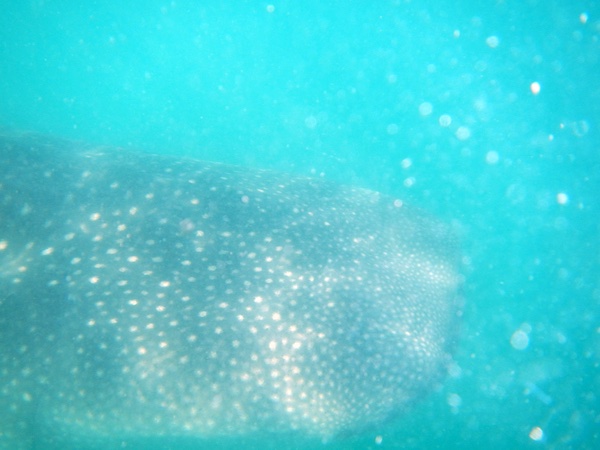
Mike got this photo of the head. Eerie.

First a few facts about how they do this whale shark tour thing here. The sharks are protected by the Mexican government. There had been too many boats going too fast, too many tour groups all at once and the sharks had been getting wounded by propellers and, in general, harassed. Poor sharks. No bueno at all. So now the area where the sharks hang out it is very protected. They don’t even let private boats in that area.

Unlike what we have experienced in other ‘protected areas in Mexico, they mean business about protecting these animals. Only 14 pangas of tourists are allowed in the protected zone at any one time, and the boats are tracked with a GPS attached to the boat. Not only that but there is actually a human being literally keeping track on a computer of which boats go where. In addition, while we were out there we were stopped by a boat of Water Guardians whose job it was to see that all the boats there were legitimately registered to do tours, everyone was wearing life jackets, and everyone was following the rules. So many rules are loosely enforced in Mexico that it took us by surprise to see this level of enforcement.

The first shark our guide spotted, a small one at about 3 meters, was outside the marked zone of protection. Our boat stopped and we got in the water to view the shark. A few minutes later the guide was on the radio explaining to the person on the other end that yes, his boat was outside the boundary; he was well aware of where his boat was. Apparently the shark had not read the rules. All was well since there is no rule about looking at sharks who swim outside of the large protected area, but, wow.

Along with the “14 pangas” rule, there is the “five people rule”. This rule states that only 5 people from any boat are allowed to be in the water viewing any one shark, and only one panga is allowed to be near any one shark at a time. This is a very important piece of knowlege for the would-be shark snorkler. Hold that one in your memory banks.

It was kind of great to be in the water again.

When we made our reservations we found out that this week was the beginning of the ‘off’ season for shark viewing tourism. This means that where last week the pangas took two hour shifts and tour guides could make reservations for a specific time slot in advance, this week they began the three hour shifts and the reservation process for tour guides was a bit looser. This was good for us in the end because we got three hours on the water with the sharks rather than two. The unfortunate part (which was really OK if you don’t mind sitting in a panga with cool people having a nice chat) was that while the dispatcher took reservations last week, this week it was a bit more of a roll of the dice which pangas would get out there when. I’m not exactly sure how this works on the back end, but here’s what we experienced as customers.

This is wildlife and this is Mexico, so as per usual, being flexible and just rolling with things without getting your knickers in a twist is paramount. We arrived at our scheduled time of 10:00AM at the Baja Expeditions office. They were hoping we could get scheduled for an 11:00 shift to view the sharks. As it turns out, we were on a waiting list and we were number 5. I couldn’t figure out why the staff seemed so over apologetic about not being able to give us a firm time when we’d be able to see the sharks. Although I’m reading between the lines here, it sounds like people complain when they have to wait and this staff bent over backwards making sure we understood how things worked and wouldn’t be disappointed. While I totally appreciated their communicating to us how it worked, I was sorry they felt so badly about it and it made me wonder if people had been less than gracious in the past.

Since everything is tightly controlled, when your boat is called you have to be ready to move immediately into the shark area. So we took the panga out to the end of the sand bar close to the entrance to the La Paz channel, nudged its nose up onto the sand, cut the engine, and waited. We waited for 2 hours before our turn came. Other pangas, full of tourists (key word: full), came and went. Our little group still waited.

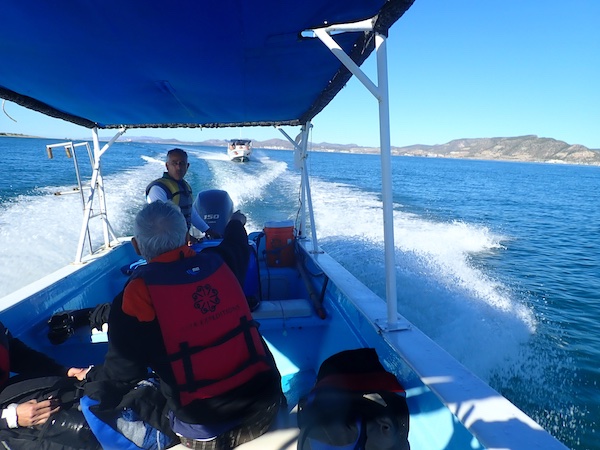
Pangas move fast! Note the guy in our wake getting a little free ride.

When we were finally called we zipped out into the bay and made haste to the area where the sharks hang out cruising for plankton. Once inside that boundary, the pangas are allowed to go only 14 knots, which is hilarious because that feels so fast to us! This slow speed allows panga drivers to avoid hitting the sharks, who glide around just under the surface of the water. The guide and the driver start looking for sharks which they identify either through their big dark forms in the water, or their huge fins showing above the water.

The routine when a shark is spotted is to see which direction it is swimming, then stop the panga well ahead of the animal. You need to be ready to move off the boat the second the boat is stopped. Make haste getting over the side. Everyone slips into the water (careful not to splash too much because they are fish and might dive down and away from you). What I learned is to stick close to the guide. He knows what to do to see the shark to best advantage. Watch what your guide does and do that thing. They put you right in the path of the animal, who doesn’t care at all that you exist. Actually I’m not entirely sure they even see us. Their eyes are small and on the side of their heads. So basically just look straight ahead under the water until the shark appears.[embedyt] https://www.youtube.com/watch?v=FY_i3J1gtFk[/embedyt]

Mike and I both made the mistake the first couple of times of thinking that the dark shadow on what turned out to be the sea floor was  actually the fish, then being startled when it appeared right in front of us. There is nothing like coming face to face with a huge gaping maw coming right in your direction, even if you know you are not plankton. These are the biggest fish in the world, and even though the ones in La Paz bay are juveniles, they are enormous. The biggest one we swam with was 25-30 feet long.

The third shark we swam with emerged from the murk so close to me that I could have touched it. (Note- you aren’t supposed to touch them) It swam under me, less than two feet away,  and I was worried its fin would snag me so I scrambled to get out of its way, because it’s huge and even if it’s not going to try to hurt me, those tails are big as they glide back and forth in the water. That was a moment of hilarity. I’m trying to swim away just a bit, also swim forward as fast as I can to keep up with the creature, and also take a film and also marvel at its beauty and the fact that I am actually here, right here in the water with this magnificent animal. There was a lot going on right then, let me tell you.

By the time I had scrambled out of range of the tail, the fish was passing me by and I had to fin for my life to catch up to it. These fish are fast. They look like they are swimming slowly, because for them, they are. But for us, it took every bit of fast finning to even keep up with the creature, much less catch it after it passed by. If you are lucky enough to be near the head, swim like a great white shark is after you to keep up with it. Otherwise you will soon be waving bye bye to its tail and honestly, you will want to swim next to it for as long as you possibly can.

Now, remember that piece about “only 5 people in the water at a time with any one shark”? Here’s where you want to be choosey about your tour group, maybe pay a little extra to keep it small, and where we got very, very lucky. Literally all of the other pangas out there had at least 10 people on them. Math is involved here so think carefully: only 5 people at a time in the water. Ten or more people in the panga. So that means all those people had to take turns getting in the water. You have a limited time on the bay and these are wild animals. They don’t read directions, they swim fast and they are too busy eating to care about your entertainment. If you have to divide up into groups then you have at most 1/2 of the opportunities to swim with a whale shark. If I had to sit in the panga and watch while another group got to swim with one of these magnificent animals,  and then when my turn came the animal was gone, would I be happy? I submit to you that I would not. Not even a little bit. I might even cry.

Baja Expeditions had a minimum of 4 paying customers at 65$ each for each tour. That price is very reasonable and actually cheaper than many places. Much cheaper than some. That includes your snorkel gear and wetsuit, if you need those things, and drinks and snacks on the ride home. (Think Coke, Topo Chico, fruit, cookies, and chips.)  It does not include tips and you’ll want to tip the driver and the guide.

Mike and I are only 2 people so we got on the radio and said we were looking for people to join us. We got one sailor who wanted to go and pretty much we were willing to just pay for the invisible 4th person if necessary. We got lucky and another couple signed up for our tour through the tour office, making a perfect party of 5. Exactly the right number for everyone to be able to go into the water at once. Winner![embedyt] https://www.youtube.com/watch?v=z379n-m_kbA[/embedyt]

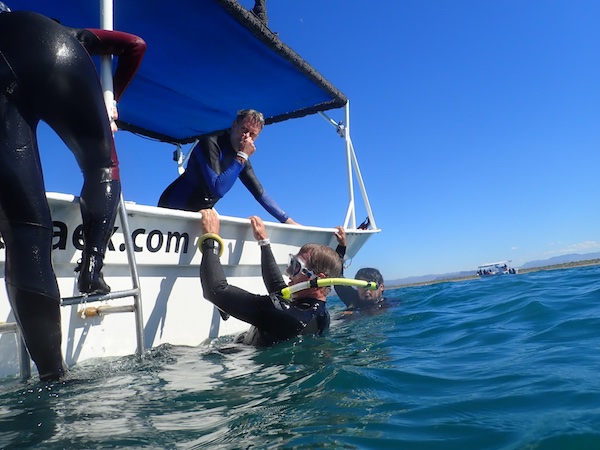
A couple more things to think about: if you go in the off season and have to wait for a spot to open up, you might end up, like we did, hanging out in the panga for a few hours. Make the best of that. We thoroughly enjoyed the other people in our group. Bring snacks and drinks (although we had those on board the panga on our tour). There probably will not be a bathroom. People are pretty good at looking the other way if you need to use the beach. Make darn sure that your panga has a boarding ladder for getting out of the water. Had ours not had a ladder, I would have still been out there swimming for home. Oh, and our guide said no sunscreen was allowed. They are probably trying to protect the ecosystem from the damaging effects of the chemicals in a lot of sunscreen. Good for them! We had a nice bimini over the top of our panga, so no sunscreen required.

With these tips you are sure to have an unforgettable experience. I know we did.

The Bungee Effect

We’re back in La Pause, I mean La Paz, that scrappy little city on the Baja Peninsula that grabs cruising boats by their jingle bells and doesn’t let go. The wind is howling at gusts to 29 knots outside; so pretty much the weather is as usual. We’re used to it now. The locals say that La Paz sports an invisible bungee cord, tying people in place for months at a time. In fact, last March we discovered that very cord during our first trip to La Paz. So we had fair warning. We knew that if we pulled into La Paz, we’d be here for awhile. Knowing what we do about the magnetic pull of the place, why did we come back? One word: services.

I found this great no-slip material at the local Home Depot.

Like cell reception. We’ve been really grateful for the excellent cellular reception in La Paz. Mike even bought a Mexican TelCel sim card for his phone, which we now use as a hotspot.  Really, it’s the only reason we wanted to be here by Christmas. We were able to talk to both our kids/their spouses and our family back in Washington, all at the same time, with video! What a Christmas miracle that was. We’re in Mexico, we’ve got kids in Paris and Ecuador, and my mom and sister are back in Washington State. What a time to be alive. It does make cruising so much easier to have good communications with people you love. Reliable cell service has also enabled me to work with clients while I’m here. I’m enjoying being ‘back in the saddle’ professionally, so we’ll be spending a little more time in areas where I can spend hours on the phone. Thanks, La Paz.

A lot of people really love La Paz. They love it so much they live here on their boats year round. We like La Paz about as much as we like any city; which is to say when you need to get things done, cities are the place to be. After that, not so much. We enjoy going on long walks each day; sometimes longer than we anticipate. We like having resources like the plastics store, which smells alarmingly like styrene and you can almost feel the braincells screaming as they die, where we bought 20 liter plastic water containers; 2 for 12$. We found a dandy material to replace our wornout cockpit mat. Mike has bought fuel filters and some unguents to clean out the fuel tank, one of our projects while we are here. He will be posting a more detailed analysis of that extended project in the coming days. Polishing fuel on your boat does have its charms. (Note to new cruisers: if you are still in the states and find a good deal on fuel filters, stock up. They are expensive in Mexico; at least the cost of what they are in the states.)

In La Paz we are experiencing some of the benefits of being in Mexico that we’ve only read about until now. This includes ordering new eyeglasses. Both of us wear progressive lenses because our eyes are old and getting worn out. Those things are expensive in the states, even if you have vision insurance, which we don’t. Accustomed to the financial trauma that is ordering new glasses (or any medical intervention, really)  back home, not to mention having to choose frames that will be comfortable for at least 2 years, we put off this drudgery until we could not stand it any longer. Mike had actually broken his titanium frames and the repair job he did on them brought the term ‘geek’ back into everyday parlance on our boat. My glasses were so scratched and worn that seeing things clearly was no longer feasible. It was past time.

We had no idea where the best place was to go and people recommended all kinds of places. So, out and about doing shopping one day we found ourselves in front of the optical shop at Walmart. Ordinarily this would not be our first choice. But why not look? Our feet carried us into the shop and the frames seemed reasonably priced. We were immediately helped by a nice woman who did her best to understand our broken Spanish. Somehow it became clear that no appointment was necessary, the eye exam was free, and she could do it for us right then. Well why the hell not, then? We went for it. When in Mexico it’s sometimes important to just go along for the ride. 

She gave us a thorough exam and very quickly was writing up a prescription for new lenses. We found quite reasonably priced frames, mine made of titanium (which I really wanted because of how lightweight they are), and soon we had ordered two new pair of glasses with lightweight polycarbonate progressive lenses for about $249 together; yes that’s for both pair together! No insurance crap, no extra anything. We were so pleased! Of course, the glasses will not be ready until January 16 or so, but we decided what the heck. We’re in “La Pause”. We’ll wait. The bungee cord adjusted a bit tighter.

People in the states are always curious about how the medical care is in Mexico. Well, I’m finding out. While we are here I decided I needed to see a doctor. I may have picked up some sort of bacteria that my body is not accustomed to and it’s not going away. Apparently it loves living in my stomach. Nothing serious, mind, I just feel like it should be checked out. So on New Year’s Eve I emailed one of the doctors listed on the Club Cruceros resources list for cruisers. This is a list of service providers that other cruisers have checked out and use regularly. I wanted to get the email out so I wouldn’t talk myself out of it, thinking I would arrange something for after the holiday.

She got back to me by email right away and then called me during our walk into town. We  arranged to meet me that very evening at the marina since we would be attending the same holiday function that evening. Whaaattt??? Let me recap: I EMAILED her and less than two hours later I had a same day appointment on New Year’s Eve.  By 6:00 I was sitting on a park bench explaining my stomach woes to a lovely woman who spoke enough English to understand me, looked at me when I was talking, and asked clarifying questions. In short, she treated me like the human being I am. She spent over 30 minutes with me, wrote me a script for some lab work and will contact me with the results when they are in. I have to go get my own lab specimen jars (3 for 1$) and take my specimens to the lab up the street.

I paid her 500 pesos in cash on the spot (about 25$) for her time and attention. No paperwork. No filling out anything at all. No weighing and measuring and charting and checklists; no waiting rooms with oversized TV’s, no telling your story to three different people, no medical billing, no muss no fuss. No overhead, either, since we met on the bench! It was a glorious feeling of freedom, seeing a medical professional who is not part of a large institutional setting where I feel like a number rather than a patient. I’ll report back when I get the labs done as to how much they cost.

Mike sports the latest in fashion eyewear. Ok, really these are just what you wear around to be sure the prescription is good.

While I’ve reported about the costs of the appointment and glasses because people are rightfully curious about those things, I’d like to say that the cost is really only one part of the overall whole of the experiences. The lack of stress, not needing to make appointments through a front desk, not having to wade through myriads of forms and procedures to get to the final product, whether eyeglasses or a simple doctor’s appointment, is the greater message here. I’m sure things would be different if we had to go to a hospital, or if we were seeing a physician in a larger clinic. But it’s nice to know that you can access medical care for minor things without all the hoopla we’ve begun to do anything to avoid back home. Gee whiz, for 25$ I might actually be able to afford to see a doctor more regularly if I need to.

I admit I am starting to get itching to be moving on from La Paz; mostly because I know how seductive it is to be in a place that has this many conveniences. The longer we stay, the harder it is to break free. The more access I have to unlimited cellular service, the more likely I am to try to work more hours per week just for the sheer joy of feeling useful again, not to mention how it helps out with the cruising kitty.  If we stay much longer, Mike will surely find another project that needs doing immediately on this old boat. We are anchored right outside the entrance to Marina de La Paz and we leave our dinghy on their secure dock almost every day. It’s easy to walk almost everywhere here and if you need a bus, the little Collectivo buses are 10 pesos, about 50 cents. They run all the time and will stop for you even if you aren’t at a real bus stop. Just wave them down. A city this size makes the living super easy. So we better get going soon. I’ve got my bungee cutting scissors in my pocket.